


Note: This article has spoilers from Season 2, episodes 1-14.
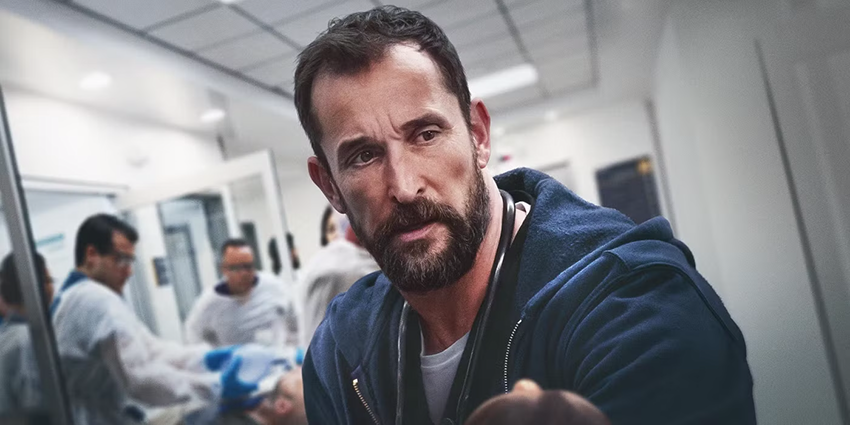
Season 2 of The Pitt continues to press its characters into the tight corners of exhaustion, moral strain, and quiet courage. At the centre of it all is Dr. Michael “Robby” Robinavitch, played with a worn, searching gravity by Noah Wyle. This season does not simply depict burnout as a workplace hazard. It treats it as a spiritual crisis, one that reshapes how a person sees others, themselves, and the work they once believed was a calling.
Robby began the season already frayed, but viewers see the result of 10 months of burnout that plays out in a single day. The signs are familiar. Shortened patience. A tendency to withdraw. Pushing co-workers away. And as the shift wares on in season two his fraying burnout affects those around him.
It’s a tough watch seeing a main character spiral, but The Pitt doesn’t shy away from making Dr Robby the non-traditional “villain” of Season 2. His anger and frustration, fuelled by burnout, is bleeding through every relationship in the ER. This is only exacerbated by this season’s crisis of a hospital cyber attack, requiring that the whole ER go analog.
Season 1 saw Robby being stripped back by his PTSD and worsening mental state. His confidence in systems, his belief in his own indispensability, even his sense of control are all eroding. But perhaps what remains is a more fragile but more honest version of himself in Season 2 and all of the people caught in his orbit are affected. And the time gap between Seasons 1 and 2 has been able to make his mental state more acute.
This shows up most clearly in his mentoring. Robby has never offered polished wisdom, but he let’s his burnout show up in unhelpful ways. When Dr Mohan (Supriya Ganesh) suspects she may have a medical issue, he dismisses it as a panic attack. When nurse Dana Evans (Katherine LaNasa) sees him treating staff poorly, she calls him out, while she meanwhile, is mentoring a young nurse Emma (Laëtitia Hollard) with care and compassion.
This shift reflects a theological truth that runs beneath the whole season. Leadership is not about mastery, but about accompaniment, addressing conflict and walking with people in their distress. Robby is learning, perhaps unwillingly, that his role is not to save everyone, but to walk with others in the work of saving. This is a hard lesson for someone who has built an identity around being the one who steps in, fixes things, and moves on.
As the season moves toward its finale, the looming reality of Robby’s sabbatical casts a long shadow. On a practical level, his absence will leave a gap in leadership. On a personal level it seems he is trying to escape his demons, by driving off into the sunset on his motorbike. But the more significant question is what he leaves behind.
This season added the additional attending in Dr. Baran Al-Hashimi (Sepideh Moafi) who came in to make a number of changes to assist staff that initially didn’t sit well with Dr Robby, but as the season has progressed through the shift there is an uneasy alliance forming.
The sabbatical itself raises important questions. Is it an act of surrender or an escape. Is Robby stepping away because he has recognised his limits, or because he can no longer bear the cost of staying. The show wisely refuses to give a simple answer. In many ways, it is both.
Sabbath, in its original sense, is about rest that restores right relationship. It is not merely a break from work but a reorientation toward what matters most. If Robby’s sabbatical follows this pattern, it could become a turning point not only for him but for those he leaves behind. His absence will force others to step into roles they may not feel ready for. It will test whether the culture he has nurtured can sustain itself without him.
Looking ahead to Season 3, the groundwork has been laid for a different kind of story. Robby may return changed, or he may not return at all in the same capacity. Either way, the question will not simply be what happens to him, but what happens to those he has influenced.
Season 2 of The Pitt resists easy resolutions. Burnout is not cured. The pressures of the emergency department do not lessen. But something shifts. In the midst of exhaustion, there is a movement toward deeper connection and more honest leadership. It suggests that even in the most demanding environments, there can be space for grace. Not as a dramatic intervention, but as a steady, sustaining presence that changes how people carry their burdens and how they carry each other.
Season 1 and 2 of the Pitt are streaming on HBO Max.