

We have never been more reachable. Messages arrive in seconds. Faces appear on screens across continents. And yet, for a growing number of people, the day ends with a quiet and specific ache that all of that activity somehow fails to touch.
That ache matters more than most of us realise, both emotionally and physically. Because the research is now clear on something that humans have felt instinctively for as long as we have existed. When we lose our connection to community, we not only just feel worse but get sicker, we disengage possibly leading to early death. And when the world around us is fracturing which, by most measures it currently is; the thread that holds the individual together is the belonging.
What belonging actually does to the body
Psychologists have understood for decades that belonging sits at the core of human need. Abraham Maslow placed it there in the 1940s, just above food and shelter. Neuroscience has since confirmed why. When we feel included, the brain releases oxytocin. When we are excluded, the same neural pathways fire as they do for physical pain. Rejection is not a metaphor. It registers in the body as injury.
The downstream effects are stark. Strong community ties reduce rates of depression, anxiety, and cardiovascular disease. Belonging buffers against psychological distress even in people who carry significant personal or genetic vulnerability. Former US Surgeon General Vivek Murthy spent years building the case, ultimately declaring loneliness a public health epidemic. His research found that chronic social isolation carries health risks comparable to smoking fifteen cigarettes a day. Not occasionally feeling alone. Chronically. Structurally. Without community.
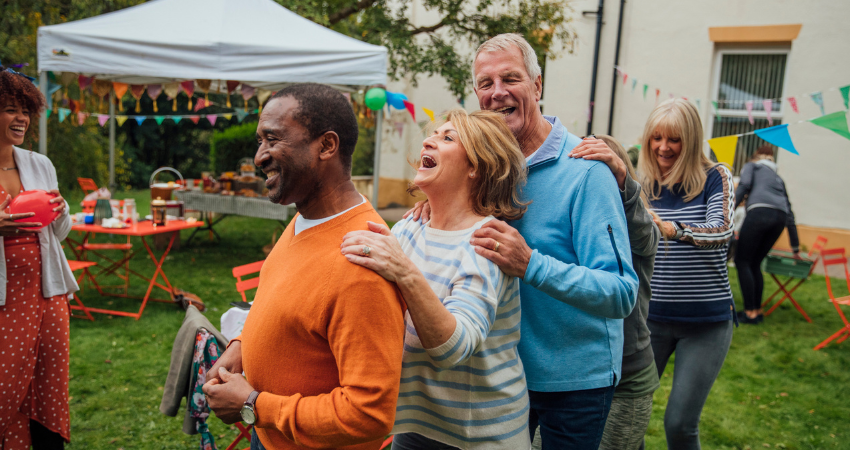
Murthy defined community in terms worth carrying around. It is, he said, the place where your presence is valued and your absence is noticed.
That definition asks nothing of geography or scale. It can be a street, a congregation, a kitchen table, a sporting club. What it requires is that people actually know each other, and that they keep showing up.
We have been quietly trading depth for reach
And yet those conditions are eroding. A Meta Gallup survey across 140 countries found that more than a billion people experience significant social isolation. In Australia, research from Deloitte Access Economics found that one in four young people aged 15 to 24 experienced loneliness in 2022, a figure that has not meaningfully recovered. Fewer people belong to civic organisations, faith communities, or neighbourhood groups than a generation ago. We move more often. We change jobs more often. We are less rooted than any generation before us.
Technology promised to close those gaps. It has largely widened them. As Murthy observed, we have moved from having confidants to contacts, from having friends to having followers. The number of connections has exploded. The quality has collapsed. The result is a generation that is perpetually reachable and structurally alone, and a world that is paying the health price for it.
Community is the reason a good life is possible
Here is what the research keeps returning to, regardless of geography, income, or circumstance. Community is not a byproduct of stability and health. It is the condition that produces them.
Australia sits in a rare and underappreciated position in that regard. As of 2026, more than 31 per cent of Australians were born overseas. Over 350 languages are spoken across the country. The Scanlon Foundation’s Mapping Social Cohesion Report 2025 found that 84 per cent of Australians agree that multiculturalism has been good for the nation. That is a remarkable number at a time when much of the world is lurching toward nationalism and exclusion. It points to something real about what becomes possible when people of different backgrounds are not merely tolerated but genuinely woven into the life of a place.
The same research found that community connections like neighbourhood interactions, shared social spaces, volunteering, simply knowing the people around you are the strongest drivers of a sense of belonging, even among those navigating entirely new countries and cultures. When migrants described what made them feel at home in Australia, it was rarely a policy or a program. It was a neighbour who stopped to talk. A colleague who included them. A community group where their presence was noticed. The everyday, unremarkable act of being welcomed.
That is what a multicultural community, at its best, actually offers. Not just diversity as a demographic fact, but diversity as a lived practice of human connection; one that expands the range of people any one of us can genuinely know and be known by. In a world fracturing along every visible fault line, that breadth of human connection is not just a social good but also a form of resilience.
Which means that the most consequential thing any of us can invest in right now is the quality of our relationships with the people physically around us. And that is the whole point.