

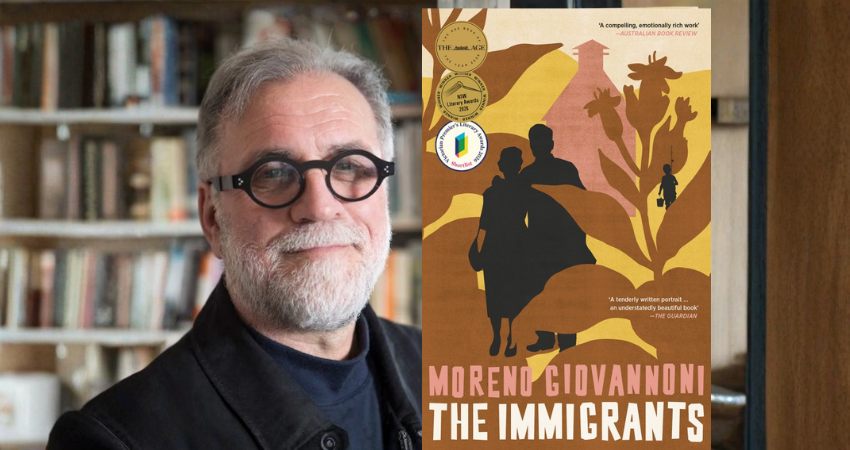
Review: The Immigrants, Moreno Giovannoni, Black Inc
In Moreno Giovannoni’s prize-winning novel, the narrator (a thinly veiled version of the author) is at one point perusing a book on Mitrefo (a thinly veiled version of Myrtleford in Victoria, a hotspot for Italian postwar immigration). He says that there is little mention of the Italian migrants and notes that immigrant stories ‘are told by the Australians [and] never told with love and clarity’. The Immigrants is, of course, a correction: a novel based on Giovannoni’s family, told with love and clarity.
It’s a work that blends fact and fiction to great effect. ‘Write what you know,’ we are often told; Giovannoni says in a note at the start of the book that it is based on his family’s history, and the history of Italian migration to central Victoria, but he takes some artistic license. He further notes that fiction has some truth to it, in the same way that our memories are faulty and don’t fit the historical record exactly but convey a feel for what happened, and also, one assumes, in the sense that while scenes are invented, the book tells a wider truth about the Italian immigrant experience.
Moreno and his mother and father are the central characters. His father, Ugo, arrives in Australia first, from Tuscany, experiencing a migrant camp and work at the Port Kembla steel works before moving to Melbourne, picking grapes in Mildura and finally settling on a tobacco farm in central Victoria. His wife and son arrive in due course.
The book is arranged not just chronologically but also thematically: as well as telling his family’s history, Giovannoni includes, in somewhat postmodern, kaleidoscopic fashion, a series of ‘grotesques’ which bring out his fascination for the macabre – an explosion in a tobacco kiln, a child dying from snakebite, a local murder – but which also enrich the background.
There is much about the process of tobacco growing and harvesting, travel between Australia and Italy and the differences between the imported culture and what there is of ‘Australian’ Anglo culture, which comes across as lacking compared to Italian culture. We quickly begin to see things through the Italian family’s eyes: the joys as well as the unfairness and ignorance of Australian prejudices, the tension between wanting a new life and longing for ‘home’.
Ugo is, at first, hardworking – and loves the work. Australia energises him – he is amazed he can be paid for as many hours as he wants to work. Later, though, a weariness descends on him, and his son wonders if Ugo has regrets about the path he has taken in life. Like other immigrants, Ugo can’t decide if the opportunities of the new land outweigh the pull of the homeland.
Meanwhile, we gradually learn about the boy Moreno – how he attaches a homemade aerial to his radio to pick up distant Sydney radio stations, how he loves solitude and intellectual pursuits, how he gradually becomes distanced from the culture of his upbringing and his father. Giovannoni sprinkles the narrative with lovingly observed details, such as how Ugo pulls down the blind in his son’s room at night, which Moreno later pulls up again in order to see the moonlit landscape, symbolic of his desire to experience the wider world.
Of course, every family’s experience is slightly different, but Giovannoni writes of common experiences: of Italian foods which are normal for Italians, but which uncouth Australians ‘fetishise’, of women attending church while the men smoke outside. Under pressure to assimilate, the Italian men learn to drink beer as well as wine, and learn to dress down, as Australian men frown upon dapper Italians, whom they see as effeminate. The boy Moreno learns that Australians are keen to place people in boxes, and sitting with other Italian immigrants in the local cinema reinforces that he is in ‘a different category of people’.

More than the immigrant experience, there are passages about the simple pleasures of childhood and farm life, as well as Moreno’s bewilderment about the adult world, the dynamics of family, the characters and institutions of small towns, the pride of farmers in their work, the nostalgia for old ways but also the acknowledgement that one moves on, the stabilities and instabilities of culture, the age-old issues of home and journeys and exile.
Nick Mattiske blogs on books at coburgreviewofbooks.wordpress.com and is the illustrator of Thoughts That Feel So Big.