

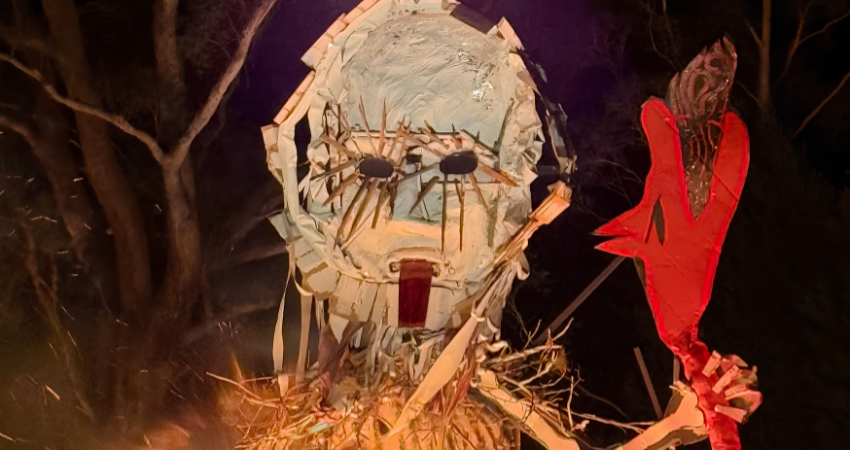
A few weeks ago we attended the Mid-winter festival at Ngununggula art gallery in Bowral in The Southern Highlands. A dusty pink sky with a few shy stars winking at me told us it was dusk. I could feel the cold settling in and I wrapped my blanket tighter around me. When we walked into the open space there was the scent of wood fires burning, mulled wine and sweaty children running about. It was beginning to get crowded as people and families piled in all keen to see the main event of this yearly, beloved local gathering. At the centre of the space there was a gigantic, wooden puppet-like figure. It looked like papier-mâché and it had wooden sticks poking out from it. The figure was white, boney and one hand was grasping some kind of animal that looked part bird and part snake. It was quite a sight. I’m sure the artist who created it spent quite a bit of time working on it and thinking about the representation.
The main event happened in the evening which was to set fire to this figure and watch it until it all burnt down. It reminded me of the well-known Burning Man festival in the USA. It also reminded me of many pagan rituals that I’ve read about. This act of constructing something then, destroying it as some kind of expiation for “sins” or perhaps as a sacrifice to the gods. Each culture and ritual has it’s own story.
Maybe that’s why I expected something more from this mid-winter gathering. Mid-winter is traditionally a time when communities of the past used to gather to invoke the gods for protection over the cold as well as preparation for the coming season.
The time came and the fire was about to be lit. The children were invited to come to light the fire if they wanted. A procession of people playing bagpipes and some others who were wearing giant masks walked through the crowd. And the fire was lit. All the mobile phones went up. There were oohs and ahhhs. And we watched the burning “person” slowly be consumed by the flames. Someone next to me said “We humans love destruction don’t we?” I replied, “Maybe this is not about destruction but purification.” There was a gentle moment to reflect on how this was speaking to us.
It was magical watching this creation fall apart, the sparks flying into the night sky. Occasionally the fire would roar and other times it was a quiet crackle. I wondered what everyone was thinking and feeling. I wondered if we could have been guided by someone to help us think about the meaning(s) behind this enchanted ritual. I wasn’t searching for direction or someone telling me what to think or believe. I wasn’t looking for religion. But I was longing for meaning. I wanted to experience something deeper than a fun night with this local community. I wanted to experience a richer shared humanity.
My husband and I watched a move called A Real Pain the other night. The main character Benji is a little unstable yet he is honest, authentic, sensitive and charming. He and his cousin travel to the land of their beloved grandma, Poland, to see the house where she lived. They go on a tour of The Old Jewish Cemetery with a guide and other people. On this tour the guide James shares with them statistics and facts about the Jewish community buried there and the hardships they faced. Benji is outraged. He finds this insensitive and lacking depth. He wants something more “real” and “felt”. There is an awkward silence in the group. They then decide to each find a stone and place them on the graves as an act of acknowledging those who suffered and died – a ritual to remember the past. Benji is soothed and he is thankful to the guide for making the experience more authentic and real.
I think Benji is right to protest against a purely rational and non-emotive take in what is such a profound moment and context. And to ask for more meaning, empathy and even perhaps for a ritual that will connect the past with the present – an act of remembering those who suffered and honouring those who died in such tragic ways.

I wonder sometimes if we are restless and untethered because we cannot find ways to become grounded – in our place, past and identity. And I wonder if we long for more connection- to the past and to ourselves and to each other. Even a connection to whatever we believe is outside of ourselves- the transcendent. Could engaging in more rituals, no matter how small, perhaps connect us and help us to live more meaningful lives? Why do you think we shy away from rituals and meaning-making?
Rev. Dr Karina Kreminski, Mission Catalyst – Formation and Fresh Expressions, Uniting Mission and Education. Karina also blogs at An Ordinary Mystic.