


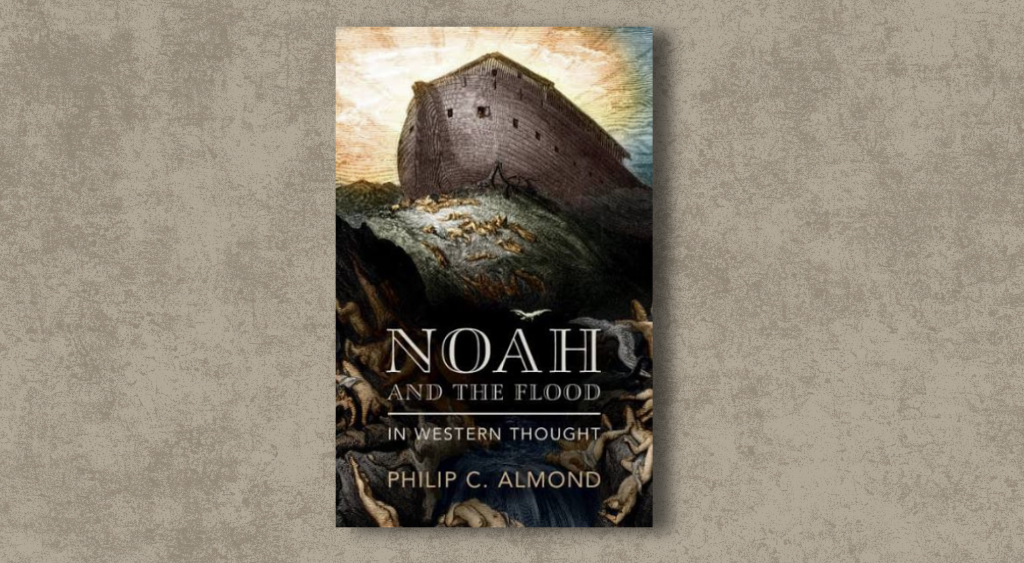
Review: Noah and the Flood in Western Thought, Philip Almond, Cambridge University Press
In his fascinating book on the influence of the biblical Flood story, Philip Almond suggests that it is supremely relevant for our time of ecological crisis and rising seas. Yet the story has been read in various ways over the centuries, as warning or promise, and in some church circles it has become the centre of a battle with contemporary science.
By the nineteenth century it was recognised that there were flood mythologies around the world. This fact could go two ways: for some, it indicated that the biblical story simply borrowed mythology from elsewhere; for those with a more literalist approach it indicated the truth of the biblical story as recorded by Moses, which was misremembered elsewhere.
Biblical scholars now assume the biblical Flood narrative was compiled after the Babylonian exile (combining at least two distinctive accounts), when it was particularly meaningful for those Israelites who considered themselves a saved remnant, like Noah’s family. Rather than being taken from the Epic of Gilgamesh, it is now recognised that the stories share a common ancestor. In the Hebrew story, however, the narrative is changed: there is only one God, who is dismayed at the wickedness of humanity, as opposed to being merely annoyed by their noisiness, and Noah is saved and enters into a covenant (key for Judaism) but is not given the immortality bestowed on his counterpart in other Mesopotamian versions.
Early in the life of the Christian church, the story was given an allegorical reading, in tune with a tendency to look for hints of Christ in the Old Testament. It is not that the story was considered untrue, but the spiritual lesson was privileged, hidden meanings searched for, and contemplation required. The Flood and the Ark were versatile, persistent metaphors: the church is an ark that carries current believers, time on the Ark was like Christ’s time in the grave, the destruction of people was like the coming judgement, the waters of the Flood destroyed the old (wicked) ways, as do the waters of baptism.
Noah was seen as a prophet in later apocryphal literature, Jewish and Christian, even though in Genesis he doesn’t try to warn his wicked and doomed contemporaries and is seemingly resigned to their fate. With the coming of the Reformation, the plain meaning was re-emphasised, and the allegorical readings drained away; Noah was just an exemplar believer, though also the (second) father to all humankind.
The design of the Ark attracted much scrutiny. The limitations of the biblical description simply prompted much speculation as to what it looked like. There were variations on a raft; Origen imagined a pyramid-shaped one, perhaps not the best for stormy seas. Almond includes in his book some delightful medieval representations of the Ark – one like the sort of ship Columbus would have sailed on, complete with sail, one with a dome, one basically a barn sitting in the water. The modern depiction – a boxy ship with a pitched roof – can be traced back to Hugh of St Victor in the twelfth century.
A literalist reading throws up all sorts of logistical problems, which Rabbinic literature, first, then, later, American creationists, tried to solve – food, waste disposal, where the waters came from and where they went, why the animals didn’t eat each other, how the animals arrived at the Ark, the sheer numbers of species, which, according to one fourteenth-century account, included ‘asps, dragons, unicorns and elephants’. One Johannes Buteo, calculating the dimensions in the sixteenth century, thought he could fit in an astonishing 3000 sheep to feed the carnivores onboard.
For centuries in the West the Bible was assumed to be the predominant historical source, understandably. But although we assume widespread literalist religious belief in the Middle Ages, all the commentary seems to point to the fact that there were some who questioned the literalness of the story. Scepticism would increase by the seventeenth century with the discovery of the Americas, and then with scrutiny of the geology, which was not necessarily led by the irreligious. (The pioneers of geological studies were often believers.)
Interest in the Ark itself may not be surprising; what might be more so is how much the repopulation of the world occupied the minds of scholars. The population of the Americas was particularly perplexing, but a sixteenth-century Spanish missionary presciently suggested an Asia-America land bridge. There was speculation about which of Noah’s sons’ descendants populated which continents. This had problematic implications, including identifying the descendants of the ‘cursed’ Ham with Black Africans, thereby justifying slavery. While most modern Christians no longer hold such views, the US, where literalist readings are strongest, is yet to shake off this racist legacy.
During the great dawning of new geological understanding in the eighteenth and nineteenth centuries, fossils on mountains which had at first indicated a global catastrophe, on closer scrutiny revealed the abyss of ‘deep time’, relegating the Flood to a localised event or simply a story with a theological rather than scientific point. Meanwhile, nineteenth-century biblical criticism brought to attention the patchwork nature of the biblical account.
Historian Ron Numbers points out that amongst twentieth century creationists there was more leeway in interpretations than might appear at first, but the Noah story is the cornerstone of creationist belief, and the theory of a global, relatively recent flood answered all the questions that the new sciences had proposed, from the extinction of the dinosaurs to the distribution of fossils to shifting continents. This involves, however, some selectivity and tortuous logic, such as, strangely, proposing a ‘fast-tracked’ version of evolution (Almond’s words, not creationists’) that accounts for the proliferation of species after the Flood, thus allowing Noah to take into the Ark a reduced number of ‘kinds’.

Literalist emphasis may be traceable to the Reformation, but its modern version was in response to the rise of science in the nineteenth century, when creationists decided that the Bible must stand up as a scientific document. Yet, as Almond points out, creationism is driven by evangelism not science, by the idea that to be saved, one must make a simple choice between atheism and an unswerving literalist reading of all of the Bible. This blunt approach has meant that creationists have attracted ridicule, though they would say: look at Noah, they ridiculed him for being steadfast too.
Nick Mattiske blogs on books at coburgreviewofbooks.wordpress.com and is the illustrator of Thoughts That Feel So Big.