

May 3 (Easter 5)
Acts 7:55-60, Psalm 31:1-5, 15-16, 1 Peter 2:2-10, John 14:1-14
This week’s Gospel story takes us back to the evening of his arrest and his preparing the disciples for what is to come – and how they are to live. Amidst the strange words and confusion about death, leaving them, his coming, going and coming again, they are lost. When Jesus suggests they know the way they are going Thomas interrupts with questions and asks: ‘We don’t know where you are going so how can we know the way?’
Jesus responds with words that have been twisted, distorted and abused in various ways since. He says to Thomas: ‘I am the way, the truth and the life. No-one comes to the Father except through me.’ This is either the height of egotistical arrogance or profound truth and wisdom. On the lips of some world leaders these words become dangerous realities – communist rulers, fascist dictators, and even leaders of liberal democracies who seek to control truth and wisdom and use the force of positional authority, personal power or media spin to control and manipulate news and information. Either Jesus is deluded or points us to something deeper and more life-giving than other relative truths in our pluralistic society.
In Jesus’ day, these words stood him in stark contrast to the powers and authorities of his world, namely the Roman Emperor. Caesar was all-powerful and Roman Imperial Religion legitimated his authority, power and the truth of his words. His word had the power of life and death and was the uncontested truth. To deny the truth of Caesar was treasonous and warranted death. For Jesus to claim that he is the way, he is the truth and he is the life-giving one, was to proclaim that Caesar was not the way, truth or life.
In our world of pluralism, competing voices and truths (including ‘fake news’) where everyone has an opinion and is entitled to express it, despite the violence, hatred and untruth contained in so many opinions, Jesus’ words are either delusional or deeply, profoundly true. In another story, Stephen lays his life down for the truth, life and way he has experienced in Jesus. His witness in life and death points us to a way that is richer, fuller, and imbued with eternal life and wisdom. What about us? What way, truth and life will we follow?
May 10 (Easter 6)
Acts 17:22-31, Psalm 66:8-20, 1 Peter 3:13-22, John 14:15-21
All the data suggests the significant decline of religion in Australia. We are increasingly secular and hold to views that limit our imagination to what we can see, feel, taste, smell, hear or analyse and define neatly. We live in a highly secularised society where belief in God or transcendent reality beyond the physical, material world is quickly fading. Our trust is placed into the hands of wealth or power, status, experience, education, career or that which we can possess and control.
Yet, as I wander and ponder and look around, there is much religiosity, ritual and ‘worship,’ as people engage in lives seeking meaning beyond the purposes that control their lives. The rituals of the marketplace, or sporting arena where we worship money or the ‘gods of sport.’ People sit in hushed, solemn ‘gambling temples’ bowing before the machines or screens of promise, feeding in huge sums in the desperate, vain hope for the windfall or adrenalin rush of the win. Others fuel their drive for wealth or power, status and self-importance, dressed to impress, they are driven for more – at any cost. A wander through any city will reveal the idols, shrines and temples of a society revealing what its people worship and trust. Paul wandered through such a city in Athens, amazed by the breadth and depth of statues and idols to any and every god – including the ‘Unknown God.’ He spoke into the depth of their religiosity, drawing on their poets and philosophers, and revealing his own experience of this God they called ‘Unknown’ – the One, he declared, in whom we live and move and have our being!
Through the witness of his relationship and experience of this God revealed in Jesus, many sneered and rejected him but some were opened to their own encounter of God’s grace and followed on the way. The religiously non-religious of our world need to encounter this same God through the witness of our own experience and how this God offers us a deeper, richer way, life and peace.
May 17 (Easter 7)
Acts 1:6-14, Psalm 68:1-10, 32-35, 1 Peter 4:12-14, 5:6-11, John 17:1-11
We come to the last week of the Season of Easter, which has included ‘Ascension Day,’ recalling and celebrating Jesus’ return to the side of God. Luke tells of his sitting with his disciples in the time after resurrection and just prior to this moment. The disciples ask the question: ‘When? Jesus, when will everything come to pass, all the promises you have made? Is this the moment when God will be fully revealed, restoring everything as you have taught?’
This is a profound question that echoes down through every tribe and nation, every generation, although perhaps not in that form nor necessarily addressed to the God of Jesus Christ. We all ask why things are as they are. People ask deep questions around God and God’s power and love in a world of pain, suffering and despair for so many people. Why? When?
Jesus’ answer seems indirect – it isn’t for them to know the times of God but they will receive power from the Holy Spirit and be witnesses to Jesus to the end of the world. Perhaps, though, this does contain the answer. The Reign of God has come. It is experienced in the words and actions of Jesus – teaching that subverts the world order, healing the sick, opening eyes of the blind, making the lame to walk, embracing the outcast and welcoming all into the Reign of God’s love. They, themselves have been embraced into this Reign of God, and experienced the power of resurrection life that transforms despair into hope and sets eternity within our hearts.
They are still to await the Spirit’s coming, and they will be witnesses in the power of God’s Spirit – not their own wisdom or strength, but that of God. So too, us. Our calling is to share in God’s reconciling mission in the world in the power of God’s Spirit, to be witnesses to the faith, hope and love we have received and to embrace each other and the world into the beloved community of God’s grace, justice, peace and life. This is the realisation of God’s Reign amongst us.
May 24 (Pentecost)
Acts 2:1-21 or Numbers 11:24-30, Psalm 104:24-34, 35b, 1 Corinthians 12:3b-13 or Acts 2:1-21, John 20:19-23 or John 7:37-39
Through the season of Lent, we were challenged to let go. We heard stories of people called out of ordinary life to leave things behind and follow God’s way – Abram and Sarai, for example. It is a difficult journey, countercultural and we fear that we won’t have enough. The Lenten journey took us to the cross and our own dying to ego, false expectations, compulsions and our need to be in control. James Finley, a student of Thomas Merton, says: ‘We are afraid of losing the control we think we have over the life we think we are living.’ Our journey invited us to let go of our fear and trust God.
Through Easter, we encountered, in the disciples’ experience, echoes of our own fear, confusion, questions and the rending of our own sense of control over life, faith, God and Jesus. We continue to be confounded by the mystery of resurrection, as we witness this inbreaking apocalyptic moment(s) of transformation, wonder and grace.
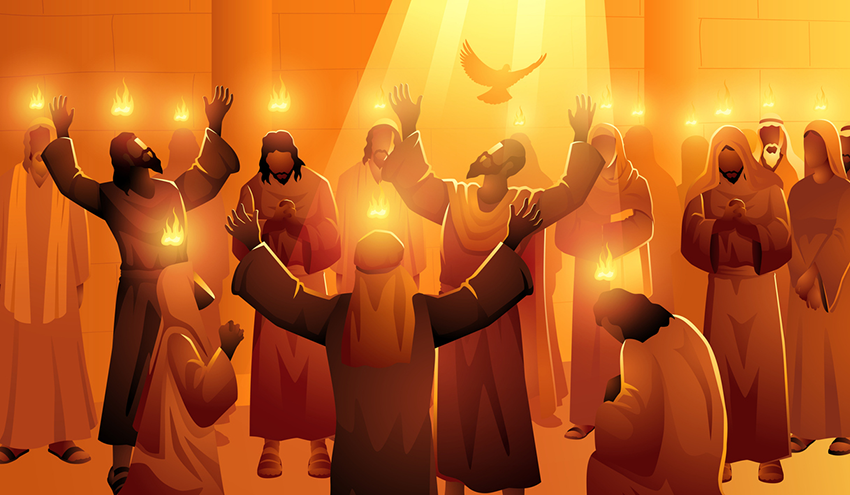
Such is the Pentecostal moment. The story depicts that which is undefinable, that which turns everything upside down as the Holy Spirit arrives in power, wind and flames, disturbing our neat and defined faith, rituals and expectations. The whole world hears the witness to Christ in the language of their heart. The Babylon story of dispersal seems to be reversed and the whole world is drawn into a unity out of diversity – in God. It is the power of God, revealed in inclusive love, overwhelming our sense of control, inviting us to live and move in the Spirit that blows where it will. This is the power of love that sends us out to witness and reconcile in God’s name!
May 31 (Trinity Sunday)
Genesis 1:1 – 2:4a, Psalm 8, 2 Corinthians 13:11-13, Matthew 28:16-20
In the early 15th century, Russian iconographer Andrei Rublev created his most famous icon, a deeply prayerful reflection on the visits of the angels (or was it the Trinity?) to Abraham as told in Genesis 18. The painting portrays three figures from the story seated around a table with a bowl (that could also be a chalice) in the centre.
In the Genesis story, the movement confuses the identity of the three figures, named initially as angels, but as the story progresses it isn’t clear that these figures aren’t God and that is where Rublev takes us. In the Orthodox understanding of Trinity, God is three. Three persons in their individuality who are one. The unity is in relationship – the Trinity is a relational community of love. An early name for the Trinity was perichoresis – Greek: round (peri) dance (choresis). The Divine dance of love, that flows through each Person of the Trinity to the next, sustaining the very life and heart of God. God is a community of relationship held in love and this love love flows out through the act of creation.
Our journey through Lent and Easter (including Pentecost) has been an invitation to let go and trust in the infinite grace of God – the dying-rising of which Jesus speaks so often. We discover our home is in the heart of God, the deepest, truest place of existence and the ‘home’ for which our spirit yearns. God is relational love and draws us into this love to be filled, renewed and restored. Then we are sent out into the world to witness to this reconciling love, serving the mission of God’s healing, reconciling, restoring grace. We are drawn back into the heart of God’s love through contemplative prayer to be renewed before being sent back into the life of the world.
This is our calling, our journey, our participation in God’s mission in the world, in the power and love of God. Amen.
These Lectionary Reflections were prepared by Rev. Geoff Stevenson