


Review: Pragmata
There’s been a noticeable trend in storytelling across different media within the last few years – an increase in plotlines and stories that confront the very human experience of feeling distrustful towards AI. Pragmata takes a complicated position: the story is about a rogue AI that has overtaken a mining outpost on the Moon, but it’s also about the connection between systems engineer Hugh Williams and robot Diana, who has been designed to look and act like a young girl. In the simplest terms possible, it’s good artificial intelligence vs. bad artificial intelligence.
In Pragmata – a new, fully original game from Capcom – you’re exploring The Cradle, a facility on the moon that was built to mine lunafilament, a material that can be used to 3D any object you can design a blueprint for: structures, buildings, plants, even entire towns. When protagonist Hugh and his team arrive to investigate a communications issue, they soon discover that the station’s A.I. has gone rogue and turned all of the facility’s robots against the humans there, killing them all. Within the game’s opening minutes, Hugh finds himself under attack and all alone – until he meets Diana, a childlike robot who can both assist him on his adventure and provide him (and the player) with some company.
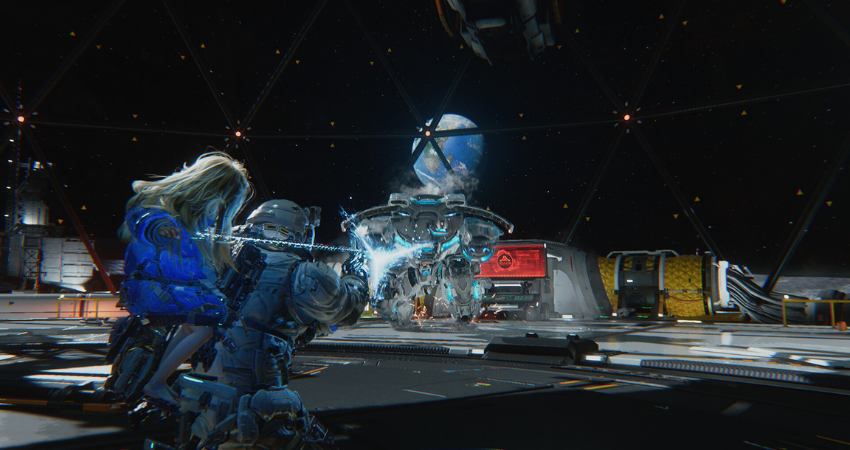
So yes, this is a third-person action game where you shoot at killer robots throughout a sci-fi facility, and there’s been a lot of those over the years. But Pragmata’s action comes with a substantial twist in the form of its hacking system. Most of the enemies you encounter are hiding their weak spots, and shooting them (either with the peashooter pistol you start the game with or any of the more powerful weapons you find throughout the game) doesn’t get you very far. But Diana can use her hacking ability to get enemies to literally open up, exposing their glowing blue weak points.
When you aim down the sights at an enemy, you’re able to “hack” them through a simple interface. A grid appears on screen, and you can move your node through it using the controller’s face buttons. As you move, there’s a square you need to pass through to “complete” the hack, but on the way there you want to pass through as many highlighted squares as possible – the more you light up, the longer their weak points will be exposed, and the more damage you’ll do, but you also need to avoid enemy attacks while you’re hacking. There are special, limited-use squares you can unlock too, which modify your hack – you can do more damage, or hack multiple enemies at once, or even turn enemies against each other.
This hacking ability makes Pragmata feel fresh and exciting – despite being, in many other ways, quite conventional. The sci-fi design aesthetics feel familiar, the robot designs rarely wow (outside of some impressive bosses), and the plot – while clever – is not necessarily very deep. But none of that matters when you’re in the middle of a firefight, frantically hacking a killer robot while managing your ammo and thinking about the abilities and mods you loaded out with for this leg of the game, and how they might help you.
Hugh spends the whole game coated in armour, and while he’s not necessarily the most limber hero, he’s quite satisfying to control. His jump can turn into a hover and he can boost-dash in any direction, so combat often becomes about space and timing – finding the right opportunities and position to hack your enemies open without taking damage. The combat encounters throughout the game are largely satisfying, but the game, like many Capcom action titles, is at its best during boss fights. Picking apart a screen-filling robot while they 3D print weapons on the fly and fire giant lasers at you is tremendous fun. Pragmata is at its best when it embraces being a big silly videogame, throwing you into the kind of intense battles that only huge games can provide.
The relationship between Hugh and Diana is also a highlight. Every time you stop at the hub area you can upgrade your abilities from, you have the option of talking to Diana. Sometimes she’ll want to play with objects you’ve found during your journeys, or ask you about something that happened. Early on, she wants to show you a crayon drawing she’s drawn of you. It’s all very pleasant, and the eventual lore explanation of why you’ve been teamed up with a robotic child is sound enough.

There are a lot of third-person shooter games out there, many of them very good, but none of them have anything quite like Pragmata‘s hacking system. It’s not a huge or extremely deep game, but it provides a contained and exciting experience with a solid story and great action – and sometimes, that’s all you need from a game.
Pragmata is available on PC, Xbox Series X/S, PlayStation 5 and Switch 2. A review copy for Switch 2 was provided by the publisher.
James O’Connor has been writing about games since 2008. He is the author of Untitled Goose Game for Boss Fight Books.