

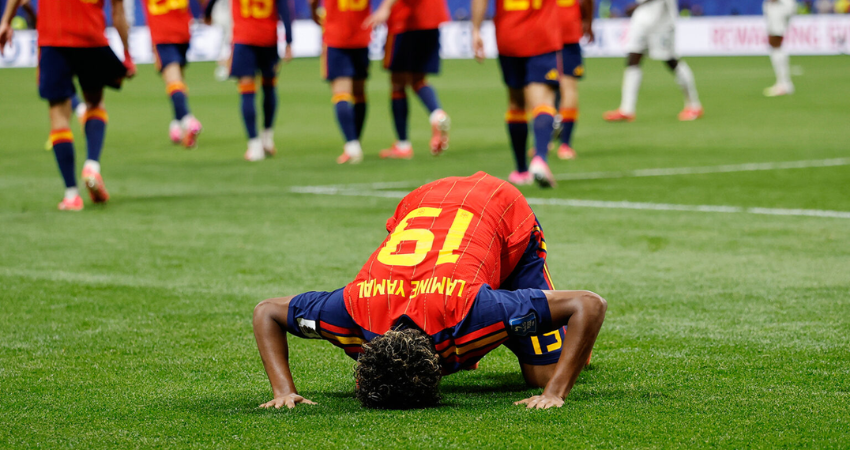
When Lamine Yamal scored for Spain in the World Cup final this morning, he did what he has done all tournament. He dropped to the turf and pressed his forehead into the grass, the Islamic gesture of prostration known as sujood, a wordless way of saying the goal was not entirely his own doing. Across the pitch, Lionel Messi has spent two decades doing something similar in his own language, a sign of the cross and a glance skyward before nearly every match of his career, one he almost certainly played his last World Cup final within this week. Two players, two faiths, the same instinct, on the same patch of grass, in front of what may be the largest television audience in the sport’s history. Nobody scripted that. It simply kept happening.
It had been happening all tournament, in fact, long before the final gave it its most visible stage. Back in the group rounds, minnows Curaçao, the smallest nation by population ever to qualify for a men’s World Cup, were thrashed 7-1 by Germany in their historic first match. What made the headlines afterwards was not the scoreline. It was the German and Curaçaoan players standing together in a prayer circle once the whistle blew, opponents a moment earlier, arms around each other’s shoulders. One German player put it plainly to reporters afterwards: on the pitch they were rivals, off it they were brothers.
That kind of instinct has a longer memory in football than people often credit. Back in 2002, Brazilian midfielder Kaká lifted his shirt after winning the World Cup to reveal a vest reading I Belong to Jesus, an image that outlasted his entire playing career. Watch enough of this tournament and you will see that lineage everywhere, whether or not the players watching it ever saw the original. American star Christian Pulisic runs a Bible study with teammates he calls Bible Time, and it was defender Mark McKenzie who led the US squad in prayer after their opening win over Paraguay. Mexico’s players pass through a small chapel before matches, two kneelers and an image of the Virgin of Guadalupe blessed decades ago by a visiting Pope. Ahead of Croatia’s opening match, two of their players spoke unprompted about what their Catholic faith gives them, one describing prayer as the feeling that someone, somewhere, is listening. After a group-stage loss to England, players from the Democratic Republic of Congo gathered on the pitch in a circle of their own, praying together in defeat rather than walking straight to the tunnel.
Argentina brought its faith with them in more tangible form. Before every match of this tournament, the team’s kit man has quietly set up a small prayer altar in the locker room, built around a statue of Our Lady of Luján, the country’s patroness, alongside images associated with urgent causes and undone knots. It is a tradition that stretches back to the squad’s 1986 World Cup win, carried forward now by a generation of players who were not yet born the last time it worked.
None of this erased the tournament’s other faiths. New Zealand’s Sarpreet Singh became the first Sikh to play a men’s World Cup match, and spoke afterwards about what that meant not just for him but for the Sikh and Punjabi communities watching. Egyptian star Mohamed Salah performed sujood after his own goals, part of a gesture that has become increasingly familiar to viewers who may never have seen it explained. Even Pope Leo XIV, days before the tournament opened, spoke about his own days playing football as a young seminarian, describing it, half-joking, as a defender’s position.
What ties all of it together is not a single religion asserting itself over the others. It is closer to the opposite. Under the most intense pressure the sport can offer, in front of the largest audiences it has ever drawn, player after player reached for the same instinct: to acknowledge, out loud and on camera, that they were not doing this entirely alone. Whether that took the shape of a cross, a prostration, a circle of arms, or a quiet altar in a locker room thousands of kilometres from home, the gesture kept repeating itself in front of billions of people who had tuned in for none of that at all.
By the time Ferran Torres scored the goal that won Spain the tournament in extra time today, deep into a final that had refused to break for over a hundred minutes, it was tempting to see it as just another moment of sporting brilliance. Torres has spoken openly himself about his own Catholic faith. Perhaps it was that too. Either way, it fit a tournament that kept insisting, whether anyone asked it to or not, that even the world’s biggest stage still leaves room for people to admit they believe in something larger than the game.