


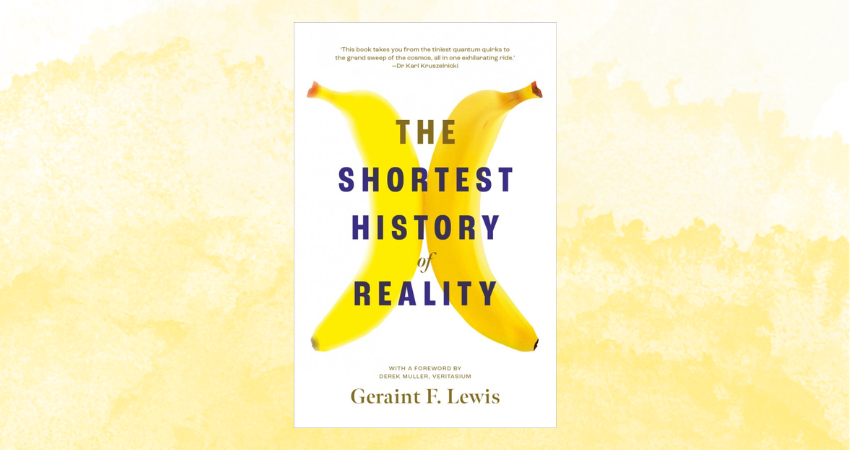
Review: The Shortest History of Reality, Geraint Lewis, Black Inc
In Christian theology there is a long history of trying to understand what it might mean for God to be the ground of reality, the prime mover, the basis of all that is (without having to ask, ‘who created God?’, which, according to theologians, is a non-question along the lines of ‘what happened before the Big Bang?’). Spiritual outlooks have tended to conceive of a world hidden behind the usual reach of our senses. Beyond Christian theology, there is a perennial interest in the basis of physical reality and a debate about whether we can ever hope to get to the bottom of it.
Modern theorists tell us the world as we perceive it is not as it is. We filter, distort, select – in sight and sound but also conceptually. Physics, you’d think, provides a more solid way of conceiving of reality, but 100 years of quantum physics has only proven how slippery and perplexing the ground is.
Practices of care of the dead hundreds of thousands of years ago show not only respect but a hope that there is more to physical existence, that reality is not just what we see and stops after death. The Greeks thought a lot about reality. For Plato, things have properties that point to a deeper reality of perfect forms – models, if you like, on which our reality is modelled (though it is a strange thing to think that a model is more perfect than the real thing).
Saint Augustine, typically, interrogated the idea of reality from all angles. He was especially fascinated with time, noticing that the present, where we live our lives, is actually a tiny point sandwiched between past and future. Augustine, says Geraint Lewis, ‘prefigured modern physics’, which lumps time in with space, and both are more malleable than they appear.
Underneath spacetime, though, there seems to be, as Descartes recognised, a deeper reality – a set of rules that go by the name of mathematics and allow the functioning of science, an objective rather than subjective view of the world. And yet, the question of how real maths is, in the sense of not being just a human construction, continues to occupy the thoughts of philosophers.
The universe running like clockwork underpinned the science of Galileo and Newton, and the notion explains much of reality at the macro level, even if Einstein and quantum physics brought major re-evaluations. (It is often said that the assumptions of a benevolent God and an ordered, predictable creation propelled advances in Western science.) At the turn of the century the old Greek idea of atoms was resurrected; investigation of their properties sent physicists down the rabbit hole.
From James Clerk Maxwell’s work on electromagnetism and Henri Becquerel’s discovery of radiation, there was a realisation that there is much more to reality than we can see, on small and large scales, from the spectrum of light waves to the dark matter that seemingly makes up the majority of the universe. With the discovery of radiation, it was realised that, contrary to Greek ideas, an atom is divisible and can alter. The likes of Ernst Rutherford discovered the secrets of the atom, now not an indivisible point but made up of smaller entities – nucleus, electrons and so on, and, astonishingly, these things were unimaginably tiny, and the atom mostly empty space, meaning the solidity of reality at the macro level rests on very little – forces as much as anything.
Einstein discovered, amongst other things, that ‘the faster you travel through space, the slower you travel through time’, and from there it just kept getting weirder. Einstein also, surprising himself, discovered that the universe is expanding – not just galaxies moving away from each other, but space itself expanding.
As the twentieth century progressed, the discovery of what Lewis calls the ‘particle deluge’ – antimatter, muons and neutrinos, and further divisions into quarks and gluons – enriched the view of reality, yet at the heart of quantum physics was a profoundly unsettling notion that reality rests on probabilities, an idea that Einstein consistently resisted but which now provides the basis for quantum computing. The related idea of entanglement – ‘spooky action at a distance’ – was for Einstein proof of quantum physics’ unreality, yet it proved to be true.
Contemplation of all this happens, of course, within the human mind, a perspective we can’t escape from. Lewis’s discussion of consciousness is open and wise: the mind is a mystery that polemical views don’t adequately concede. Reality is encountered through the mind, but how the brain produces consciousness – the awareness that we are thinking – remains unexplained, meaning that our entire conception of the world around us remains unexplained.
Lewis also manages to cram into his short book how quantum physics has prompted all manner of strange conjectures (little more than thought experiments), such as the multiverse, reality being simply a hallucination of mathematics, and the idea that we live in a simulation. And advances in science have not exactly dispelled the idea of the spiritual; the idea of the Big Bang was taken up by theologians as agreeing with the biblical idea of a moment of creation; some speculate on angels or aliens being visitors from other dimensions.

The probabilistic nature of quantum physics has been used to suggest that free will is not so illusory. On the other hand, quantum investigations suggest ‘now’ is not a universal and the past and future aren’t as straight-forward (or backward) as we think. At the most extreme, this speculation leads to the idea of a ‘block universe’ where all of time and space exists as… well, a block. Meanwhile, for most of us, the necessity of making our way in the world means we filter reality for what can be immediately useful and understandable, as our brains are designed to do, and this is as much a picture of reality as the one painted by quantum physicists.
Nick Mattiske blogs on books at coburgreviewofbooks.wordpress.com and is the illustrator of Thoughts That Feel So Big.