


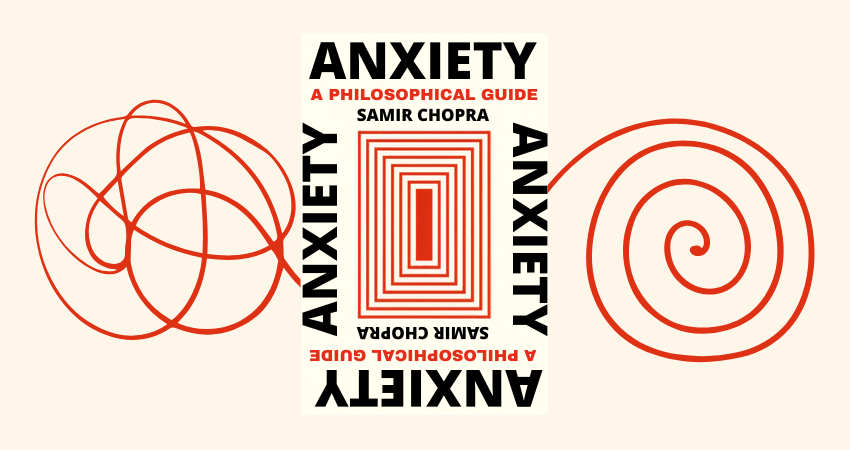
Review: Anxiety: A Philosophical Guide, Samir Chopra, Princeton University Press
Just like how each generation, as they mature, thinks the youth of today have no respect, it seems that every generation thinks it is a particularly anxious one, though there may be good reason to think that in the current age anxiety is on the increase.
The causes of anxiety seem less pin-down-able than those of fear, says Samir Chopra, the crippling nature of anxiety stemming from a vague sense of future trouble, from the unknown rather than known, though it’s true that we can also have baseless fears. Anxiety seems disproportionate and unable to be banished through reason. Sometimes the anxious can’t quite pinpoint what they are anxious about – it’s a feeling in the gut, though tethered to the mind. Theories of anxiety variously describe it as due to material or psychological or spiritual pressures; it is described as mental or physical, as natural and unnatural. Although often linked to depression, it seems a heightening of feeling rather than a dulling of it.
Those with precarious health or finances might have reason to be anxious, but the rich and powerful can be too, for the same feelings of precarity, as might the merely comfortable. Chopra says that with all our technological progress, we seem to be no closer to stability, and suspect technology will not, in the end, save us. Of course, some people are not anxious (or do they only seem so?). But humans are in a unique position to be able to think long and hard about the possibilities, and hence to get anxious about something that is not an immediate threat.
Philosophers and psychologists might be more susceptible than most, hence they write books on the subject. Chopra argues that philosophy helps us think anxiety through, and so can be both problem and cure. Moreover, philosophy is born of anxiety. Religion is too, we might add. Both are responses, in their different ways, to anxiety about meaning and fulfilment and uncertain futures, which is to say that they are simply responses to life.
Chopra’s book is an attempt to understand anxiety, which is part-way down the road to managing it. (He doesn’t pretend to offer a cure.) He offers snapshots of how various philosophical traditions deal with it, sometimes contradictorily. Through his own personal story, he shows that management is not easy – anxiety is paralysing – and combatting it can feel circular and not progressive. But philosophy can show us how to live with anxiety and see it as a natural, if annoying, part of us.
Buddhism aims to create, first, acceptance of the way the world is to alleviate anxiety. Techniques of calming taken from Buddhism pervade the self-help genre, but the Buddha taught that anxiety is rooted in dissatisfaction with the world, or awareness of its flaws, and this must be confronted. This is an existential quest: an effort to accept transience and pain (something which lies also at the core of the biblical Garden of Eden story).
For Buddhists, anxiety is also related to what could happen to the delusion we call the (autonomous) self. We manage anxiety by targeting who/what anxiety targets, a humble calling. Although it has traditionally dealt with individual salvation, Christianity too has elements of de-centring – this is at the core of the mystical experience, as well as the notion of selfless care of others, which distracts us from our individual stresses and desires.
Buddhism, though, is especially difficult in an individualistic society, and it differs from Christianity in its vision of the afterlife: for Buddhists, there is no self to go to heaven, though difference is not as stark as might be assumed, considering the aforementioned dissolution of self in Christian mysticism.
For existentialists, anxiety is just a sign that we’re alive – like, perhaps, the sore legs of a marathon runner, and like the marathon runner, we must push through the pain. Anxiety is where the rubber of philosophy hits the road of emotions. Or roads, plural, as, for existentialists, anxiety is inevitable when we make decisions about where our life’s journey will take us. For Kierkegaard, anxiety is related to the effort of creating the works of art that are ourselves, and as with the best art, we must innovate and forge our own style. Kierkegaard might also say, were he alive today, that the likes of social media are a distraction from the process of building ourselves, a retreat to comfort but not an ultimate answer to anxiety.
The existentialists saw some freedom in this, perhaps different to Christian predestination, but there are Christian existentialists too, Kierkegaard being the most famous, as existentialists value authenticity; Christian existentialists recommend the narrow but authentic choice of service to others and faith in God. (What unites Buddhists and existentialists is the injunction to see the world as it really is.)
For Kierkegaard, it is the unknown future that causes anxiety. This won’t change – we can’t know the future – but we can (must) go forward in trust, and boldly. Kierkegaard’s take on anxiety is also tied to notions of sin and doing what we shouldn’t do. Conversely, Kierkegaard can also explain why we are anxious when, as St Paul says, we don’t do what we want to do.
For Freud, in contrast, anxiety stems not so much from future uncertainty, but from traumatic events in the past. It is not so much about pushing through the pain but about understanding and letting go of anxiety that needles us from history. Besides, to equate anxiety with freedom doesn’t quite seem right – it restricts us. Anxiety doesn’t feel like a sign we are taking charge of life.
Frankfurt School philosopher Herbert Marcuse suggested anxiety in modernity is a feature of modernity and not natural. He criticised the existentialists for positioning it as a bit of pain that is necessary for gain. And while existentialists make this something noble, Marcuse criticises them for their fatalism – suggesting the causes of anxiety can be addressed, especially if they are societal ills. Additionally, he reminds us that we are in a society, not a group of isolated, heroic individuals.
Society can be a source of anxiety if we are just cogs in the machine, contributing to someone else’s profits. Nowadays we are also cogs in social media, our lives increasingly built around access to constant information and a relentless pace which is anxiety-inducing. The flipside of this is a desire for quick fixes. Chopra notes that we want to rid ourselves of anxiety, but those who take medication to lose anxiety sometimes say it is as if they have lost a part of their personality.
Chopra is darkly honest about his own battle with anxiety and feelings of inadequacy, and Tolstoyan in his expansive descriptions of a life of uncertainty: the contingencies of family, romance and culture, friends and family distant, careers unfulfilling, death the only inevitability, just as it is another unknown. But he concludes that we must live with some anxiety, just as we need to confront the societal issues that exacerbate anxiety. We can learn to view an emotion like anxiety as if from outside, to understand and control it.

We can do things to take us outside our individualistic outlook, from hiking to volunteering, and recognise love in the world. We can moderate anxiety through the cultivation of patience and the community inherent in religious ritual, we can practise regular disconnection from contemporary society, and we can empathise with others who suffer as we do.
Nick Mattiske blogs on books at coburgreviewofbooks.wordpress.com and is the illustrator of Thoughts That Feel So Big.