

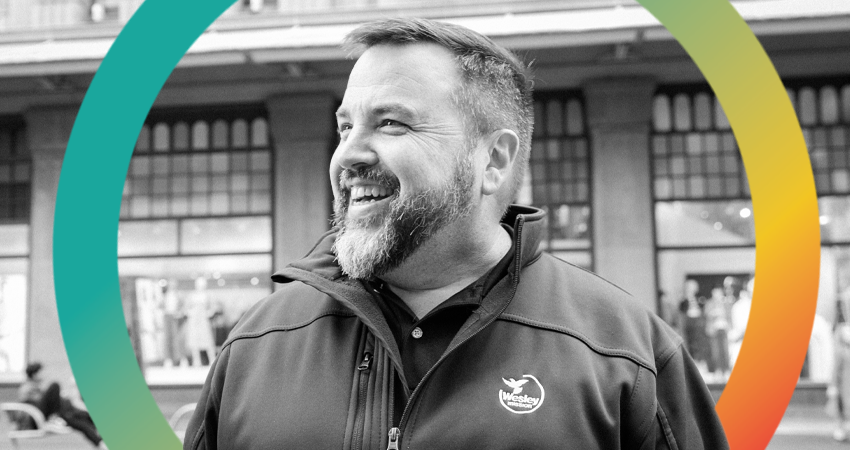
For Rev Dr Rick Dacey, ministry is not an abstract calling. It is lived out in real places, among real people, often in the most complex and challenging circumstances of life. That conviction — quietly held but consistently practiced — shapes both his leadership at Wesley Mission and what he will bring to ONE this October.
As Senior Minister of Wesley Mission, Dacey occupies a unique space within the Australian church landscape. Wesley Mission is not simply a congregation. It is a large-scale community services organisation, working across homelessness, mental health, aged care, financial hardship, and more. It is, as the organisation itself describes, a place where faith is expressed in both “word and deed.”
That dual identity shapes Dacey’s ministry.
Since stepping into the role in 2012, he has worked across every layer of the organisation, from congregational life to frontline services. It is a position that requires both theological clarity and practical wisdom. And it has formed a leadership style that is deeply relational, attentive to context, and grounded in the conviction that the gospel must be visible in everyday life.
Rick’s work is shaped by a simple but demanding idea: that authentic faith is not measured only in what is said, but in what is done.
At Wesley Mission, that looks like a church embedded in the life of the city, supporting those experiencing homelessness, walking alongside people facing addiction, and advocating for systemic change. The organisation reaches tens of thousands of people each year through a wide network of services, all driven by a vision to “do all the good we can.”
For Rick, this is not an optional extra to the Church’s mission. It is central to it.
In internal reflections on his role, he speaks of the privilege of seeing “God’s kingdom values… lived out in tangible ways,” particularly through lives and communities being transformed. That emphasis on the tangible — on faith made visible — sits at the core of his leadership.
It also shapes what he is likely to bring to ONE .
While some voices at the event will focus on theology or cultural analysis, Rick brings something complementary: a lived expression of mission. He represents a model of church that is not withdrawn from society, but deeply engaged with it, where worship and service are not separate activities, but part of the same calling.
That perspective matters in a time when many churches are asking what it means to remain relevant, faithful, and effective in a changing world.
Rick’s approach does not begin with strategy. It begins with presence.
Rather than asking how the Church can attract people back, his context asks a different question: how can the Church be present where people already are, particularly in places of need and vulnerability? It is a shift from attraction to incarnation, from expecting people to come, to going where they are.
This aligns closely with the vision of ONE .
At its heart, ONE is about renewal, not as an internal reset, but as a reorientation towards God’s mission in the world. Rick’s leadership offers a concrete example of what that can look like when it is taken seriously. It shows a Church that is not defined primarily by attendance or programs, but by its impact in the community.
Importantly, this is not about activism disconnected from faith. Wesley Mission’s identity remains explicitly Christian, grounded in the life and teachings of Jesus. But it resists the idea that faith can remain private or contained. Instead, it insists that the gospel must be embodied, in relationships, in service, and in the pursuit of justice.
That insistence brings both credibility and challenge.
For those attending ONE , Rick’s voice is likely to cut through abstraction. He speaks from a context where the stakes are real: where ministry intersects with poverty, crisis, and vulnerability. It is a reminder that the Church’s calling is not only to gather, but to be sent.
There is also a strong relational dimension to his leadership. His role requires building connections across a wide and diverse organisation linking congregations, staff, volunteers, and community partners. That emphasis on relationship echoes one of the central themes of ONE: that unity is not an idea, but something that must be lived and sustained.
In that sense, Rick embodies the kind of leadership the event is seeking to cultivate grounded, outward-facing, and attentive to both people and place.
He is unlikely to offer quick fixes or grand theories. Instead, he brings something more enduring: a steady witness to what it looks like when the Church takes its mission seriously, not just in principle, but in practice.
As the Church gathers in October for ONE , his contribution will serve as both encouragement and invitation.
Encouragement, because it shows that faithful, impactful ministry is not only possible it is already happening. And invitation, because it calls the Church to imagine how that same integration of faith and action might take shape in its own context.
Not as an ideal to admire.
But as a way of life to step into.
Visit the ONE websitefor more information and to register.