

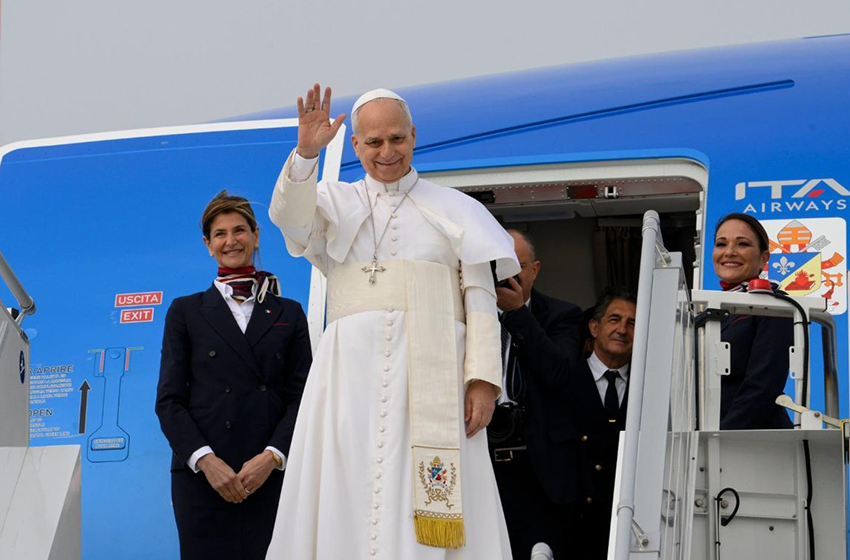
In a pointed address during his visit to Africa, Pope Leo XIV has warned against the misuse of faith for power, calling out leaders who use religion as cover for political, military and economic gain.
Speaking in Bamenda on Thursday 16 April, the Pope addressed the harm caused when something sacred is turned into a tool for influence and control. His comments came as part of a wider message on war, violence and exploitation during his trip through the region.
“Woe to those who manipulate religion and the very name of God for their own military, economic, and political gain, dragging that which is sacred into darkness and filth,” the Pope said.
The remarks reflect a long standing concern within the Church about the distortion of faith for personal or national interest. The Pope’s words place that concern in today’s global context, where conflicts and political struggles often carry religious language or justification.
The Pope’s statement also comes at a tense moment in his relationship with Donald Trump. In recent days, the two have exchanged public criticism, particularly around issues of immigration, war and the pope’s comments on violence in Iran.
Earlier in the week, Trump took to social media to criticise the Pope, calling him “weak on crime” and accusing him of being ineffective in matters of foreign policy. He also suggested the pope was acting more like a political figure than a spiritual leader, urging him to “get his act together” and stop aligning with what he described as the “Radical Left.” Trump later repeated these claims in comments to reporters.
The exchange has become one of the more public disagreements between a pope and a sitting US president in recent memory. It has drawn attention not only because of the personalities involved, but because it touches on deeper questions about the role of faith in public life.
So far, the Pope has avoided responding in kind. Instead of engaging in personal attacks, he has kept his focus on principle. While travelling earlier this week, he made it clear he did not want to be pulled into a political argument.
He said he would continue to speak about peace and justice, describing this as central to his calling. “That’s part of preaching the Gospel,” he said.
For many in the Church, the Pope’s approach is a reminder that Christian witness is not about winning arguments or gaining influence, but about pointing people back to the truth of the Gospel. His warning in Bamenda serves as both a rebuke to those who misuse faith and a call for believers to hold fast to what is sacred.
As global tensions continue and political rhetoric grows sharper, the Pope’s words challenge leaders and communities alike to examine how faith is being used and to ensure it remains a source of light rather than a tool for power.