

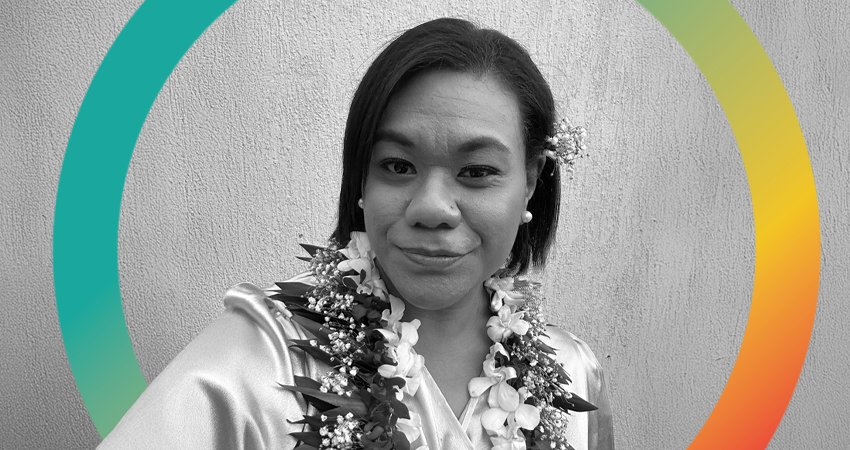
Rev. Fa Matangi brings something distinctive to the life of the Church: a lived ability to move between worlds. Between generations. Between cultures. Between the inherited traditions of faith and the emerging questions of a new generation.
That work — often unseen, always relational — sits at the heart of her ministry. And it is precisely what she will carry into the ONE event this October.
Fa’s leadership has been shaped in the intergenerational and intercultural spaces of the Uniting Church, particularly through her work with young people and communities across Queensland. As a minister working in youth and young adult ministry, she has spent years building environments where faith is not simply taught, but experienced, where younger voices are not sidelined, but centred.
One glimpse of this comes through her involvement in large-scale youth gatherings like Easter Madness, where she has helped create spaces that connect faith with real-world issues. Reflecting on one such experience, she spoke about the importance of helping young people see beyond themselves: “we are part of something bigger than our local churches… awesome work is getting done outside their own suburbs.”
That instinct to widen perspective is central to her approach to mission.
For Fa, intergenerational ministry is not just about including different age groups in the same room. It is about forming a shared imagination. Helping people recognise that the Church is larger than their own experience, and that God’s mission is already unfolding beyond the boundaries they might assume.
This is particularly important in a cultural moment where generations often operate in parallel rather than together.
Matangi’s work pushes against that fragmentation. She has developed a reputation for creating spaces where younger and older voices meet, not in tokenistic ways, but through genuine relationship. Her leadership reflects an understanding that each generation carries something essential: wisdom, energy, memory, and possibility.
In that sense, her ministry is as much about listening as it is about leading.
Her own story also shapes this work. As a second-generation Tongan Australian, Matangi inhabits multiple cultural identities at once. That lived experience gives her a natural ability to navigate difference, to understand both the richness and the tension that come with holding together diverse perspectives.
It also informs her approach to mission.
Rather than seeing mission as something the Church does to others, Fa consistently frames it as something the Church participates in with others. This aligns closely with broader Uniting Church movements toward partnership, justice, and global awareness, particularly among younger generations who are deeply attuned to issues of inequality and inclusion.
Her involvement in wider church structures, including Synod leadership and interfaith engagement, reinforces this outward focus. She has contributed to conversations that extend beyond the local church, recognising that mission today requires both local presence and global awareness.
But what makes Fa’s voice especially important is not just her perspective it is her tone.
She brings a disarming honesty to ministry. By her own description, she does not present herself as “altogether,” but as someone navigating the same complexities as those she serves. That openness resonates strongly, particularly with younger generations who are often wary of polished or overly certain leadership.
It also reflects a deeper theological truth: that God works through people as they are: whole, broken, and in process.
This is where her contribution to ONE becomes particularly significant.
As the Church gathers around the theme of unity “that they may all be one” Fa’s work offers a grounded expression of what that unity can look like in practice. Not a static ideal, but a lived reality shaped through relationships across difference.
She is likely to challenge participants to think differently about leadership: less as control, more as connection. Less about having all the answers, more about creating space for others to speak and belong.
And she will likely bring a particular focus on emerging generations, not as the future of the Church, but as its present.
In a time when many churches are asking how to engage younger people, Matangi’s ministry suggests a shift in the question. It is not simply how to bring young people into existing structures, but how to allow the whole Church to be reshaped through intergenerational encounter.
That is not always comfortable. It requires humility, adaptability, and a willingness to let go of control.
But it is also where renewal begins.
At ONE, Fa will not simply speak about intergenerational ministry as a concept. She will embody it bringing a voice that is relational, culturally aware, and grounded in the everyday realities of faith.
A voice that reminds the Church that unity is not found in sameness. But in learning how to belong to one another, across every difference, as part of God’s unfolding mission.
Visit the ONE website for more information and to register.