

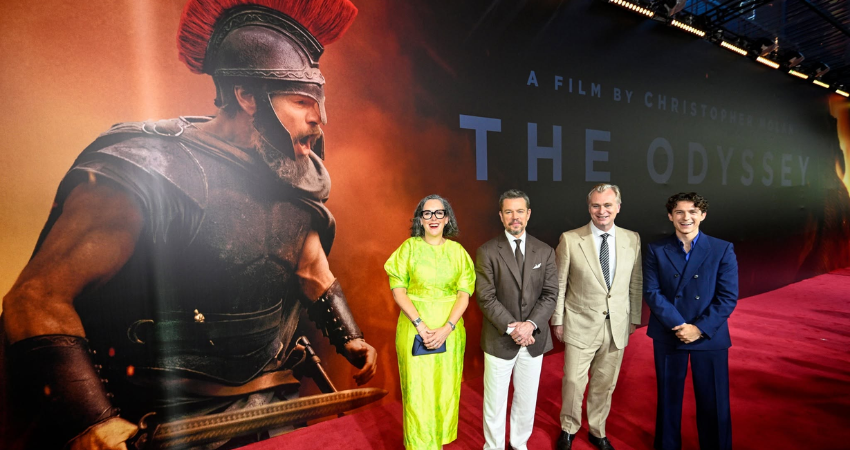
Christopher Nolan’s Odyssey opens today having already made history before a single ticket was scanned. Shot entirely on IMAX 70mm film across more than two million feet of footage, it is the first film ever to presell IMAX tickets a full year in advance, and they sold out within the hour. The global publicity tour runs eleven days across six cities and three continents, an ensemble cast reads like a best-of list of the last decade of Hollywood, and somewhere in the middle of all that scale, three of its biggest stars spent an afternoon doing something remarkably small.
Growing up in Mumbai, an Irani cafe was never an occasion, just an ordinary Tuesday of chai in a glass and a shared table with strangers. So when Christopher Nolan, Matt Damon and Tom Holland turned up at Olympia Coffee House in Colaba for bun maska (butter) before their Mumbai premiere, sitting at the same marble tables generations of ordinary Mumbaikars have eaten at, it was a strange thing to watch unfold from afar. It was no unplanned detour. It was a calculated stop, chosen and timed by a publicity machine that understands exactly what a photo like that is worth, and that is precisely what caught my eye about it. There was nothing this trio could have bought that afternoon that they couldn’t already afford. What money had bought them instead was the appearance of wanting to sit where the ordinary sits, briefly, as equals. That is a small, deliberate impulse, and it points to something much bigger about just how far this promotional campaign has been willing to go to make three thousand years of poetry feel worth caring about again.
The poem itself is a ten-year voyage home, longer than the war that came before it. Odysseus spends it fending off the Cyclops Polyphemus, the sorceress Circe and the deadly Sirens, while his wife Penelope holds off suitors back in Ithaca and his son Telemachus grows into a man he barely knows. Strip away the monsters and it is a story about the distance between where you are and where you belong, and everything that tries to keep you from closing that gap.
Odysseus survives large stretches of that distance because of a code as old as the poem itself. The Phaeacians take in a shipwrecked stranger, feed him and hear his story before ever asking his name. The Cyclops, by contrast, is monstrous precisely because he does the opposite, eating the guests he ought to have fed. Hospitality to the stranger is not a theme laid over the top of this film from the outside. It is the moral architecture Homer built the whole poem on, and scripture holds the same instinct. Abraham ran to welcome three unknown travellers under the trees at Mamre, not realising who they were until well into the visit, and Hebrews later put the principle plainly, that some who showed hospitality to strangers were entertaining angels without knowing it. Different centuries, same impulse, the same table, the same one that greeted three film stars in Colaba this month, staged or not.
If the cafe was the quiet version of that instinct for scale, the rest of the campaign is the loud one. Days after the Mumbai stop, a Trojan Horse roughly eleven metres tall and weighing close to four tonnes appeared overnight in London’s Trafalgar Square, having already loomed over the world premiere in Leicester Square before touring American cities outside cinemas, the way the real horse once turned up outside the gates of Troy. A studio has spent an enormous amount of money staging the oldest trick in Western storytelling as a piece of publicity, and it says something about the size of the task at hand, that reintroducing a three-thousand-year-old story to a modern audience apparently requires a full-sized wooden horse crossing three continents to do it.
Nolan himself seems to understand exactly what he is trying to reintroduce people to. Ahead of the release he described wanting to capture the leap of faith ancient sailors made setting out into an unmapped, uncharted world, faith here meaning something closer to the trust it takes to survive the unknown than any particular creed. He has spoken elsewhere of the story’s heart as a homecoming, a love story, a family finding its way back to each other, which tracks with everything Homer actually wrote. Whether the finished film leans into any of that as heavily as the poem does remains to be seen. Early reporting suggests Nolan is chasing scale and myth first, and it is entirely possible the deeper currents stay under the surface of the spectacle rather than announced outright.
That would not be out of step with the source material either. Israel took forty years to cross a distance that should have taken weeks. The prodigal son’s road back was longer than the walk out ever needed to be. Odysseus tied to the mast, the pole that holds a ship’s sails, so he could hear the Sirens without steering onto the rocks, is not so far from anyone who has had to remember who they are before they could find their way back to who they love. The poem has been carrying that weight quietly for nearly three thousand years, long before it was written down at all, which is a long time for a story to last if it were only ever an adventure.
Whatever Nolan’s Odysseus turns out to be once audiences actually see it in the coming weeks, Homer’s has already been teaching people about longing, temptation and home for far longer than any studio campaign could manufacture. Perhaps that is why a carefully staged tea stop in Colaba still made international news, even knowing it was staged. It borrowed something true from the very story it was selling, that the most human moments rarely announce themselves with fanfare, and that most of us, famous or not, are still finding our way home to the same simple things.