

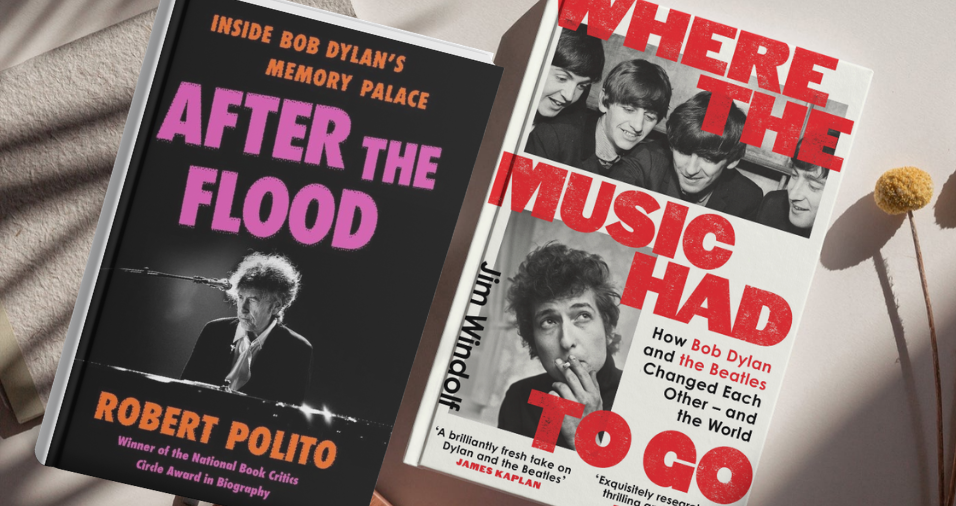
Review: After the Flood: Inside Bob Dylan’s Memory Palace, Robert Polito, Liveright and Where the Music Had to Go: How Bob Dylan and the Beatles changed Each Other and the World, White Rabbit
The flood of Bob Dylan books continues. (Dylan is one of the most written-about musical figures.) Last year we had Ron Rosenbaum’s Bob Dylan: Things Have Changed, a personal exploration of themes in Dylan’s music and a sometimes-grumpy argument that much of Bob’s work is theodicy. Harry Feeman’s Jewish Roots, American Soil is a less angry book about Dylan’s Jewish heritage – a subtle influence, considering Dylan’s distancing himself from that heritage. Steven Ring’s recent What Do You Hear? audaciously argues that there hasn’t been much analysis of Dylan’s musicality, as opposed to his wordsmithing, and Rings makes up for it with a very technical analysis of Dylan’s guitar playing and deliberately ragged voice.
Robert Polito’s After the Flood, about Dylan’s late career ‘comeback’, might be the cream of the recent crop. The best Dylan books have a certain style, with jokes, sarcasm, poetry, personal injections – it seems writing about Dylan lifts writers towards Dylan’s level. Polito is up there with Dylanologists Greil Marcus and Clinton Heylin. He draws from the almost-inexhaustible well of Dylan’s music, film, radio shows, books and paintings to show how Dylan fills his work with references to ‘songs, poems, novels, films and gags’, as magpie and archivist.
It is like Dylan and his biographers to treat the 1980s, the mid-point slump, as a Greek tragedy – like an underworld descent. The truth is probably more that the times didn’t suit him. Oh Mercy was something of a revival, but Polito points to the early 90s albums of old songs as the necessary reset. With the covers, Dylan immersed himself in the past to ready himself for the songwriting of Time Out of Mind onwards, which aped the thematic smorgasbord of American folk history. No-one has immersed themselves like Dylan – throughout his career, though the early 90s was a rebaptism.
Our ‘ears reel and our minds lurch,’ writes Polito. In one song he unpicks, a dozen other writers can be glimpsed. On the album Tempest, beyond Shakespeare, Polito sees references to Homer, Ovid, Tennessee Williams, Poe, Edward Fitzgerald, Blake, Yeats – and that’s before we get to all the folk songs Dylan’s referencing. Dylan mentions American wars and deliberately conflates John Lennon and St John on Patmos.
Polito writes about Dylan’s excursions into filmmaking and the Nobel Prize acceptance, as well as the constant re-interpretations of his catalogue on the ‘Never Ending Tour’. With Shadow Kingdom, re-recordings of old songs, Dylan emphasised that any version is simply ’a snapshot’, and the ‘timeless’ sound of newer recordings means that Dylan blurs the lines between himself and the great American songbook, which he has also covered extensively recently. When Dylan writes of other people’s songs, as he does in the book The Philosophy of Modern Song, says Polito, he is more autobiographical than in his memoir Chronicles, because he has not only immersed himself in the pantheon of songwriters but inserted himself.
Jim Windolf’s Where the Music Had to Go illustrates the seemingly never-ending opportunities for niche Dylan writing. Here, Windolf explores the surprisingly close relationship between the Beatles and Bob. The title of the book comes from Dylan himself, who said that he saw the Beatles as pointing to the future of music, while Paul McCartney said that they were ‘both going toward the same thing’.
At first, Lennon and Dylan didn’t think much of each other’s music, but the sophistication of Dylan’s lyrics soon influenced the Lennon/McCartney songwriting, and Dylan recognised the craft underpinning the deceptive simplicity of the Beatles’ joyous songs.
The Beatles obviously owed much to the home of blues and rock, while America experienced Beatlemania and looked to London as a cultural centre. As the Beatles tried to progress their sound, Lennon and McCartney said Dylan influenced them to try less-romantic songs in favour of the likes of ‘Norwegian Wood’. Dylan, who had started as a rocker before going folk, played down his relationship with the Beatles but may have been influenced by them in ‘going electric’.
Windolf sees links between ‘Yellow Submarine’ and Dylan’s ‘Rainy Day Women’. Then, after the indulgences of Sgt Peppers and the White Album, Lennon, embarrassed by their experimentation, said that Dylan’s John Wesley Harding had inspired the Beatles to go back to basics, to the early rock’n’roll that had so inspired the young Dylan and Beatles. In turn, Lennon’s gift for simple lyrics such as ‘All You Need is Love’ inspired Dylan to write less cryptic songs like ‘I Threw it All Away’.
Lennon had a love/hate relationship with Dylan, prompted by the rift within himself between the rocker and his more intellectual side. Being Lennon, this wasn’t resolved easily. Both artists were awkward in conversation yet articulate in song and on stage. Lennon copied Dylan’s sartorial style and mimicked his singing on ‘You’ve Got to Hide Your Love Away’.

Lennon and MacCartney were somewhat awed by Dylan, yet Dylan has, over his career, repeatedly made pilgrimages to key Beatles sites. Dylan and Lennon even embraced Christianity at the same time. (Lennon’s conversion was short-lived, and he later ridiculed Dylan’s gospel turn.)
George Harrison and Dylan were less rivalrous and simply more friendly. The guitar on the cover of Dylan’s Nashville Skyline was a gift from Harrison. Harrison often played Dylan’s songs, and, in inviting Dylan into the Traveling Wilburys, helped Dylan get out of his 80s slump, helping set Dylan up for the flourishing of his late career.
Nick Mattiske blogs on books at coburgreviewofbooks.wordpress.com and is the illustrator of Thoughts That Feel So Big.