

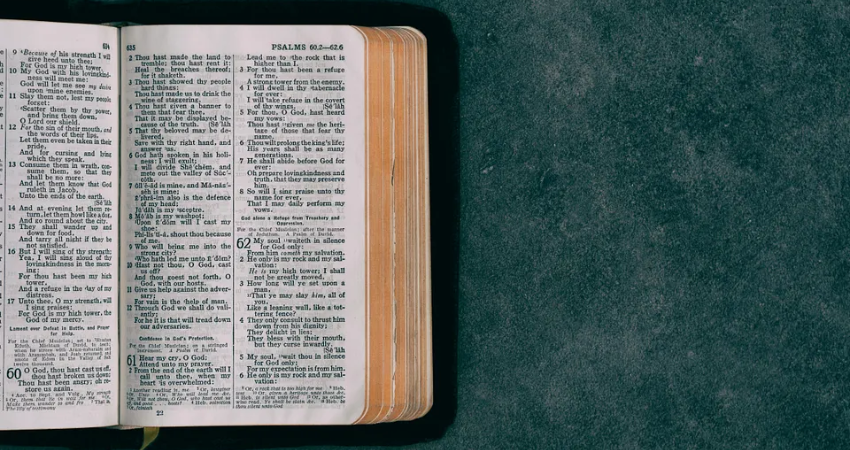
We have never had more access to the Bible, and we have rarely known it less.
Consider what sits within reach of almost anyone today. Dozens of translations, available in an instant. Study Bibles thick with footnotes. Commentaries, concordances, apps that locate any verse in seconds, podcasts and reading plans without number. The text has been searched, cross-referenced, and annotated to a degree no earlier generation could have dreamed of.
And the surveys keep telling us the same sobering story. Biblical literacy is collapsing. People who own several copies of Scripture cannot say what is inside them. The book at the foundation of the faith has become, for many, a closed and distant object, respected from afar and opened rarely.
Something has gone wrong, and I want to suggest it runs deeper than a shortage of information. We have learned to treat the Bible as a thing to be studied, a body of content to be mastered, a quarry of facts and principles to be extracted and applied. That approach, useful as it can be, has slowly starved us. We have gathered information about the Word while missing the encounter the Word was always meant to be.
Contemplatives and activists knew a different way. For them, Scripture was a living voice, a burning bush, a place where the soul met the living God and came away changed. They prayed the book, ate it, wept over it, and carried it into the world. And the way they read holds a cure for our hunger.
The Word That Speaks
Begin with what the Bible claims to be.
The Scriptures present themselves as something far more alive than a manual or a record. They speak of the word of God as living and active, sharper than any two-edged sword, piercing to the division of soul and spirit. They describe a word that refuses to return empty, that accomplishes what it sets out to do, that tastes sweeter than honey and shines more precious than gold.
This is the language of encounter. The prophets received no bullet points. They received a word that seized them, burned in them, would not let them rest. Ezekiel was handed a scroll and told to eat it, to swallow it whole, and on the tongue it tasted like honey. Jeremiah spoke of the word as a fire shut up in the bones. The Bible understands itself as the place where God speaks, and where the human heart, listening, is set ablaze.
To read it as data is to read against its grain. The book wants to address us. It wants to question us, comfort us, unsettle us, call us by name. Every time we open it, we are welcomed into a conversation with the One who breathed it, present in the words, waiting to meet the reader who comes with an open and listening heart.
The Ancient Ladder
There is an old practice that knows how to read this way. The tradition calls it lectio divina, sacred reading, and it has fed the people of God for many centuries.
In the twelfth century, a Carthusian named Guigo described it as a ladder with four rungs, set on the earth with its top reaching into heaven. The four movements have guided countless readers ever since.
Reading comes first. You take a short passage and read it slowly, aloud if you can, letting the words move through you without hurry. You read for depth, listening for the word or phrase that shimmers, the line that seems to be meant for you today.
Meditation follows. The older writers called it rumination, the chewing of the cud, the slow working of a phrase until its flavour is released. You take the word that caught you and turn it over, repeat it, sit with it, let it sink from the head into the heart.
Prayer rises next. The word has spoken to you, and now you speak back. You answer God out of whatever the text has stirred: gratitude, confession, longing, lament. The reading has become a conversation.
Contemplation completes the ascent. Here the words grow still, and you simply rest in the presence of the God they have led you to. There is nothing to achieve. You stay, like a beloved resting in the arms of Love, held by the One the text was always pointing toward. The reading has carried you past the page and into the presence of the Author, which is where it meant to bring you all along.
Those Who Ate the Book
History overflows with people who read this way and were transformed.
The elders of the Egyptian desert, in the early centuries of the church, soaked themselves in the Psalms until the words became the rhythm of their breathing. They prayed the Scriptures through the day and the night, repeating a single verse until it worked its way into the marrow. For them the Bible was the food of the soul, taken daily, chewed slowly, swallowed whole. A short passage held in the heart could feed a person for years, and they trusted it to do exactly that.
Augustine, restless and unconverted in a Milan garden, heard a child’s voice chanting, “Take up and read.” Augustine opened the Scriptures, eyes landing on a sentence from Paul, and the words pierced to the centre. A whole life turned on a single reading. The text became the doorway through which grace walked in.
Centuries later, in the shadow of the Third Reich, Dietrich Bonhoeffer practiced daily meditation on Scripture and taught a hidden seminary to do the same. Bonhoeffer insisted that we come to the Bible to hear God address us personally, lingering over a single verse, listening for the voice of the living God. The word Bonhoeffer received in prayer became the courage Bonhoeffer carried into resistance, all the way to a prison cell and a scaffold.
During the struggle for civil rights, the prophets of Scripture came alive on the tongue of Martin Luther King. The vision of Amos, that justice would roll down like waters and righteousness like an ever-flowing stream, became the heartbeat of a movement. King read the prophets as a living fire, present and burning in the American moment, and the words reshaped a nation.
And Dorothy Day, serving the poor in the houses of hospitality, read the Sermon on the Mount as a way of life to be obeyed. The beatitudes became marching orders, lived out in soup lines and picket lines and the daily company of the forgotten. The text moved from the page into the streets and took on flesh.
The Rung the Activists Made Visible
There is a final movement that the activists threw into sharp relief: action.
Reading that ends in contemplation is not yet finished. The Word that has been read, chewed, prayed, and rested in longs to be lived. It seeks hands and feet. It wants to become flesh again, embodied in a life that feeds the hungry, welcomes the stranger, and stands with the oppressed.
This is the genius of the ones who married deep prayer to bold action. They understood that to truly hear the Word is to be sent by it. The encounter on the page becomes the encounter on the street. Scripture read as encounter always presses outward, into a world aching for the Word made flesh.
(This is the way of life I explore in my forthcoming book, Ten Movements of the Jesus Way.)
How to Begin
So how do you start reading this way? Start small, and start slowly.
Choose a short passage, a few verses, no more. Find a still and unhurried space, and a handful of minutes you can give without rushing. Read the passage slowly, perhaps aloud, and notice the word or phrase that catches you. Stay with it. Repeat it gently, letting it settle into you. Then speak to God about whatever it stirs. And finally, let the words come to rest, and simply remain for a little while in the presence they have opened.

Then carry the word with you into the day. Let it shape a choice, soften a response, prompt an act of love. Let it become flesh in the way you live.
This is the reading that turns information into intimacy. It asks you to slow down, to read a little and listen a lot, to come to the page expecting to meet someone. The point was never the volume of text you could cover. The point was always the voice you could come to know. And this reading offers, to anyone willing to listen, the very thing our information age has left us starving for: a living encounter with the God who still speaks, in words that are sweeter than honey and stronger than death.
Graham Joseph Hill is the Mission Catalyst – Church Planting and Missional Renewal for Uniting Mission and Education. This post is an edited version of a post from his Substack here.