


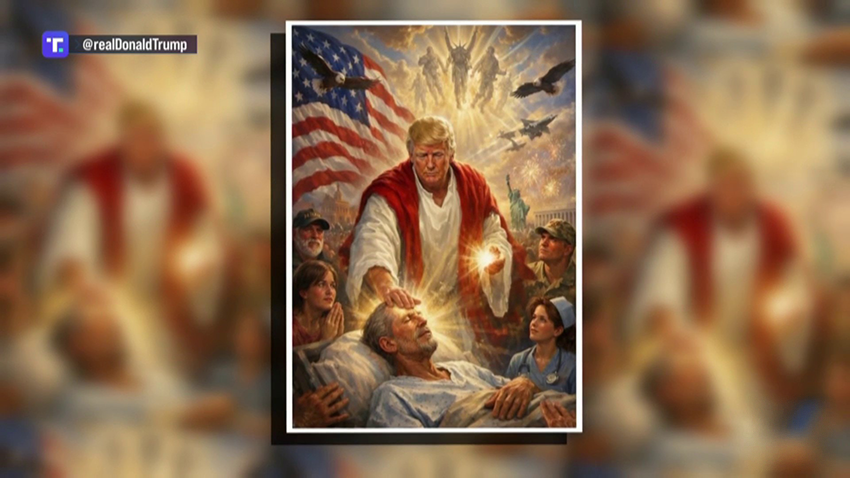
A wave of anger has swept across Christian communities after Donald Trump shared an AI-generated image portraying himself in a Christ-like role, prompting senior faith leaders and religious commentators to denounce the post as blasphemous and spiritually dangerous.
The image, posted to Trump’s Truth Social platform and later deleted, depicted the former president in flowing robes, radiating light and appearing to heal a sick man. The symbolism was unmistakable. For many Christians, it crossed a line that should not be blurred.
The backlash was swift and unusually unified. Evangelical and Catholic voices, many of whom have previously supported Trump, publicly rebuked the post. Some described it as a misuse of sacred imagery, while others went further, calling it an act of sacrilege.
Conservative commentator Megan Basham was among those who spoke bluntly, calling the image “outrageous blasphemy” and urging Trump to remove it and “ask for forgiveness… from God.”
Even media figures sympathetic to Trump expressed concern. Megyn Kelly described the image as “blasphemous” and “completely inappropriate,” warning that it suggested a man placing himself in the role of God.
The criticism is significant not only for its tone but for its source. Trump has long relied on support from conservative Christian communities. Yet this incident revealed cracks in that alliance, with some of his most reliable supporters publicly distancing themselves.
The timing added to the offence. The image appeared during the Easter season, one of the most sacred periods in the Christian calendar, when believers reflect on the suffering, death, and resurrection of Jesus Christ. For many leaders, the juxtaposition of political self-promotion with holy imagery was deeply troubling.
Christian theology has historically treated claims of divine likeness with great caution. The figure of Jesus is not merely symbolic but central to the faith as the Son of God, whose humility and sacrifice stand in stark contrast to displays of power or self-exaltation. It is this contrast that many leaders say makes the image particularly offensive.
One unnamed administration official, speaking candidly, admitted the post went too far, describing it as “sacrilegious at best,” even in a political culture where supporters sometimes use messianic language about leaders.
Trump, for his part, dismissed the criticism. He claimed the image was intended to depict him as a doctor or healer, not as Jesus. Yet critics argue that explanation fails to account for the overt religious imagery embedded in the picture.
The controversy also comes amid a broader pattern of religiously charged rhetoric. In recent weeks, Trump has drawn criticism for comments about Pope Leo XIV and for language that some faith leaders say treats religion as a political tool rather than a sacred trust.
For many Christian observers, this latest episode is not an isolated misstep but part of a troubling trajectory. The concern is not simply about one image, but about a pattern of behaviour that appears to instrumentalise faith for personal or political gain.
The image may have been taken down, but its impact lingers. It has reignited questions about the relationship between political power and religious identity, and about the responsibilities of leaders who claim the support of faith communities.
In the end, the response from Christian leaders has been clear. Sacred symbols are not political props. And when they are treated as such, the reaction is not just political outrage, but theological alarm.