

Review: Days, The Mountain Goats
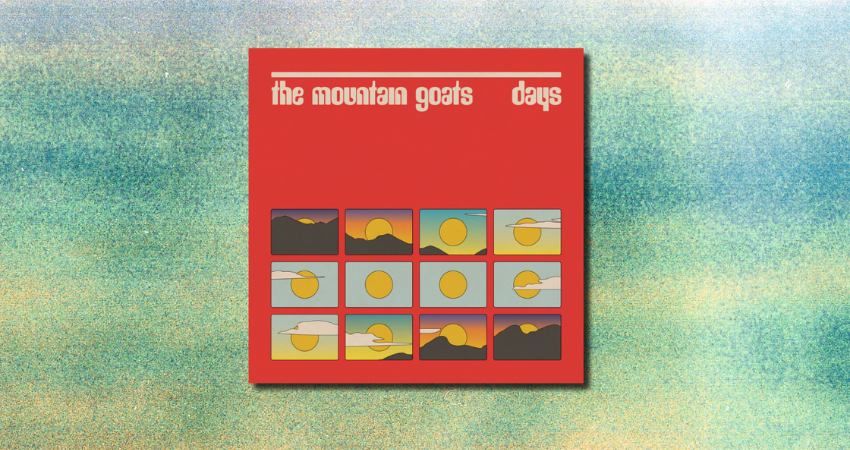
If John Darnielle is worried about the march of time, he is certainly cramming a lot in – albums more than once a year; last year we had his book of lyrics and commentary, This Year. Now we have his latest album, a meditation on entropy and decay and time’s arrow, I suppose, but also on the surprise and wonder of, as Darnielle put it in a recent interview, just waking up with all of the world around us, holding us.
A feature of Darnielle’s music is telling stories, often from left field, in which he avoids focussing on his own ego or desires. He says he prefers the songs to speak, rather than the singer’s persona, refreshingly contrary to much rock star behaviour. The stories on this latest album are a mixed bag, but he says he was thinking of Orpheus (not Odysseus), dealing or not dealing with change, and how if you hold onto something to try and freeze it, what you have will change anyway. Such is life.
The themes in the album are leavened by the arrangements, which are bright, and Darnielle has moved well beyond the sparse, lo-fi days, a sound which, he says, he took as far as it would go, and which, I suppose, rode on the coattails of grunge’s turn from the lushness of 80s music (though he says he wasn’t really into grunge). Here, Darnielle is taking inspiration from yacht rock and benefitting from more time in the studio.
Recently, Darnielle has continued his tradition of thematic albums. The previous album, Through This Fire Across from Peter Balkan was a ‘musical’ about, of all things, a fishing boat being shipwrecked. Jenny From Thebes was a rock opera, Bleed Out was an album inspired by trashy action films. Half of the new album is about music and musicians, a path well-trod by Darnielle. He seems fascinated by rock musicians as historical figures.
‘Candlebox’ is about a fictional band supporting Candlebox, with the twist that subsequent to the song being recorded, The Mountain Goats did actually support Candlebox. (So I hear.) ‘Annie Haslam Imperial Phase’, with its horns that recall a song like ‘Clean Slate’ from Jenny from Thebes, is about the band Renaissance.
Opener ‘Song for Layne Staley’ is about the doomed Alice in Chains singer and references the pitfalls of fame: ‘I don’t want this/I don’t need this’. There’s a recollection of the past here that moves beyond nostalgia to thinking about how the past is remembered – what lingers, what disappears.
‘Woodstock 99’ is about the notorious festival that descended into chaos and destruction. It’s nevertheless a poetic evocation, with some artistic licence in recalling the debacle that is the subject of a riveting documentary that highlighted the poor planning and nihilistic atmosphere (that nevertheless some festival goers recall fondly). It is delivered in incongruously plodding piano ballad style, and the lines ‘behold the heavy century/buckling with the strain’ and others indicate, perhaps, that the festival, to Darnielle, was a kind of fitting, inevitable chronological nadir.
Darnielle explains in his book This Year that he often fills notebooks with song titles, the details to be fleshed out later. The song titles, he writes, are the ‘key’ to unlocking the secrets of the sometimes-obscure lyrics. One could imagine this process behind a song like ‘Hidden Majesty of Later Venom Albums’ and ‘The Best Hard Rock Albums of 2013’. Regarding the former, one couldn’t imagine a song further from Venom’s music: it is most un-thrash metal, with spare piano chords, angelic choir and a chorus of sparkling, tumbling triplets tending towards a Fleet Foxes sound. (Darnielle seems to like this kind of juxtaposition.) The song fits into the overall theme by being observations about the late-career stage.
‘The Best Hard Rock Albums of 2013’ has a throwaway line about a list, but it’s more about a mosaic of impressions that contribute to the overall theme of time passing quickly. And who else would manage to cram into a stanza both the lines ‘egrets in a salt marsh’ and ‘rock’n’roll all night’?
The song ‘Days’, with its, dare-I-say, lush, floating arrangement of strings and Zooey Deschanel-style backing vocals, is something of an older person’s song, a contemplation of the existential issue of the briefness of our time on Earth. The hope of an afterlife might be a comfort for some, but most of us, as we get older, still feel the onrush. Older people often comment on how quickly their life has passed.
The second line of the chorus, ‘When they’re gone, will you be ready?’, may seem like it is referring to being ready for death, but in a recent interview Darnielle alludes to another, more mundane, reading: you won’t be ready when your children have grown up. It’s common for parents to think that their children’s childhoods went too fast: ‘Where did the time go?!’ In response, Darnielle seems to be encouraging us to delight in little things: ‘Ice cream tastes good in the afternoon’.

The closing song, Last Day, is a kind of coda to Days, with upbeat organ and a more direct emphasis on death being more of a resolution than loss, probably taking inspiration from and sounding like some Black gospel anthems, at least lyrically if not musically. Indeed, the song contains some biblical-sounding phrases referring to restoration in the twinkling of an eye, such as ‘what was broken will then be put together again’.
Nick Mattiske blogs on books at coburgreviewofbooks.wordpress.com and is the illustrator of Thoughts That Feel So Big.