


Review: Star Wars Zero Company
In 2026, many Star Wars fans have a complicated relationship with the series. Not every movie has hit; the ever-expanding franchise has become ungainly; a series of cameos, Easter eggs, and unsubtle winks have made the galaxy far, far away feel far, far smaller than it should. Star Wars: Zero Company is the latest Star Wars story, a turn-based tactical strategy game set during the height of the Clone Wars. And indeed, the game, which is heavily inspired by Firaxis Games’ XCOM series, also feels somewhat derivative, at least at first. But the deeper I dug into Zero Company, the stronger the impression it made, and the more it stood out.
You play as Hawks, a character whose voice, appearance, and even species you define at the start of the game. You are the commander of a private mercenary outfit, working under the thumb of the Hutts (or whatever Jabba’s equivalent of a thumb is). The eponymous company soon finds themselves pulled into something bigger than their team is equipped to handle, tracking a fanatical cult that is spreading a disease known as the Shadow Plague, which ingratiates some of its recipients with enormous strength and kills others. Soon the members of Zero Company find themselves working directly with the Republic to deal with this growing threat, which, for players, means guiding your squad through a series of turn-based battles.
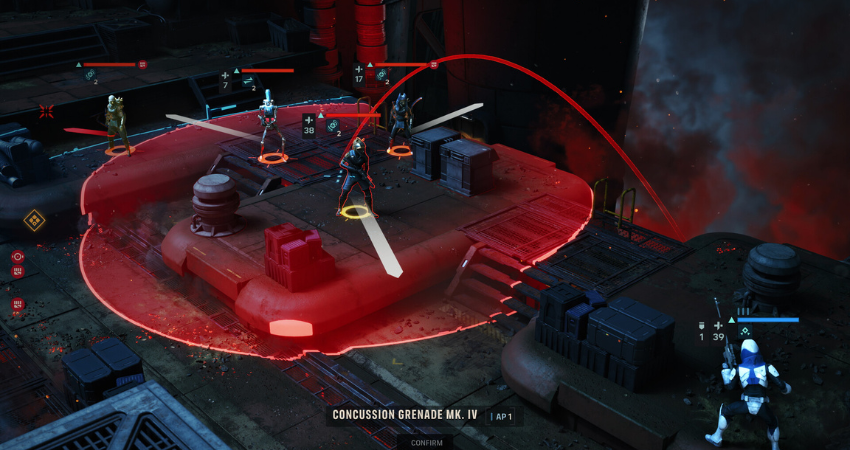
Zero Company has a lot of Star Wars flavour packed into the margins: the story cutscenes, the iconography of the various alien races, the slightly-sanitised dialogue and light political intrigue. But it’s also a game that you could play with very little understanding of, or investment in, Star Wars, and still enjoy. The main pull here is the tactical battles, which are consistently smart and engaging. You enter into each tactical battle with four characters, made up of a mix of the main story-centric squad and whoever else you’ve pulled in from the recruitment menu back at your base. Each character has different weapons and abilities, and each of them gets three “action points” per turn.
Action points (AP) can be spent on movement, attacks, and using different weapons and abilities. One character might have a gun that takes two AP to fire, for instance, and the other AP could be used to move, or to heal, or to use a debuff attack. Another character might be able to take three shots per turn, but they do less damage; in that case, you might want to set them up in “overwatch” mode, so if up to three enemies move into their line of vision next turn they’ll shoot at them, potentially stopping them in their tracks. Oversight is one of the game’s most straightforward pleasures: set it up and watch as your foes run right into your trap next turn.
There are deeper tactical layers that emerge over time. Each turn, one member of your squad is able to call for support, designating another character to fire upon any enemy they take a shot at. Planning and executing a two-pronged attack is a great feeling, and the gameplay loop ensures that you can, potentially, experience it on every single turn. There is also a shared “Advantage” point pool that builds up as you fight, giving your squad access to more powerful attacks. Saving your points and immediately hitting a wave of reinforcements with a rocket launcher blast is immensely satisfying. As battles grew more intense as the game went on, I grew to appreciate the unique abilities of each member of my crew (which includes a Jedi warrior, so there’s some lightsaber action to break up all the guns). I never played through a fight where I regretted bringing along a certain character, or found myself in a battle that was clearly designed for a team different from my own. It’s always possible to adapt and strategise through Zero Company‘s skirmishes. The game also has a “permadeath” option turned on by default, which means that if any character becomes grievously injured three times in a single battle you’ll lose them from your squad. It’s not too difficult to keep everyone alive, but this mechanic gives everything an extra sense of weight, and protecting each member becomes about more than just playing the game well. Outside of battle, you can level up characters, chat with your crew, refine your team composition, and – crucially – make a bunch of choices with wide-ranging implications. Star Wars Zero Company is a game with a lot of overlapping systems and trackers, but it never gets too intimidating. You have some control over not only your squad, but also how your enemies evolve and change, through simple story-based decisions made outside of battle. It’s not the deepest choice system, but it’s a great way of getting you more invested in this particular corner of the Star Wars universe.

The one sour note I had with the game, playing on PlayStation 5, is how poorly optimised it was. Several cutscenes looked terrible, the camera would frequently get stuck on walls mid-mission, and the game either stuttered severely or fully crashed on a handful of occasions. The game feels very close to being finished, rather than actually being finished. The game’s development was reportedly very dramatic – much of the team was furloughed just before launch – and you can feel it in these pain points. It’s a shame, but not enough to hold this back from being the most interesting Star Wars project since Andor.
James O’Connor has been writing about games since 2008. He is the author of Untitled Goose Game for Boss Fight Books.