

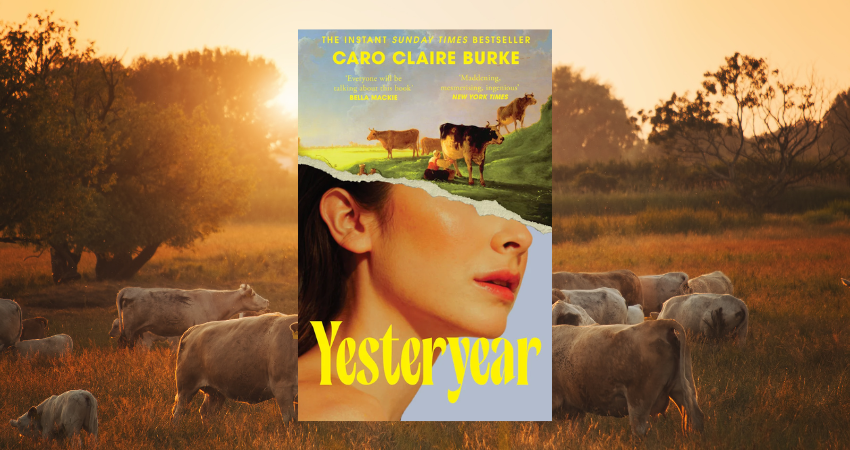
Review: Yesteryear, Caro Claire Burke, Fourth Estate
Natalie is a tradwife influencer living on a farm called ‘Yesteryear’. She has millions of Instagram followers who watch her feed chickens, raise a brood of children and bake bread in her old-style kitchen filled with glass jars and carefully curated clutter. What the followers don’t see are the immigrant workers out in the fields, the videographer, the two nannies and the massive refrigerator in the walk-in pantry.
We learn about Natalie’s history: she is smart and raised in a conservative Christian family. At university her classmates think she might be Amish; she doesn’t drink or chase boys. She takes charge, in her own smart way, not getting caught up in a modern world that promises equality to women but doesn’t deliver. After a brief courtship of a young man she meets in church, she marries him – a ‘nice, dumb rich kid’ whose father happens to be a senator and has money to provide them with the farm.
Burke cleverly constructs Natalie as a complex character, not as a bimbo. She has a nasty side and is ambitious. She looks down on city women who talk about organics but have little connection to the land. She has a love/hate relationship with her audience who gullibly buy whatever merchandise she is peddling. She swears a lot in her interior monologue and then apologises to God. (‘Sorry, Lord’.) Eerily, she compares the presence of her followers with the unseen presence of God. She’s a piece of work, and yet we can sympathise a little in the way she observes modernity’s contradictions and kicks at expectations in her own way.
One day she wakes up on her farm, with her husband and children, yet somehow they are all not quite the same, and it is as if she has time-travelled to the 1800s. Not only is there no refrigerator, there is also no electricity or running water. Unlike for Marty McFly, there is no obvious means of return.
At first, Natalie is understandably terrified, and there is more swearing (and not so much apologising). She tries to flee but her leg is caught in the jaws of an iron animal trap, injuring her ankle and curtailing her options. There are signs that things are askew – she wonders if she has found herself in some clever reality show; she wonders if God is testing her somehow. (The believability of all this may vary from reader to reader.)
At times it feels like, as a reader, you’re caught in an iron animal trap yourself and would chew your own leg off to escape. And yet part of Burke’s craft is that despite Natalie’s personality we want to find out what happens to her, both in the backstory of her climb to social media fame and the cracking of its façade, and in her trap of an all-too-real Little House on the Prairie. How the heck did she get here? How does she escape?
Of course, the irony in these contemporaneous narratives is that while Natalie celebrates the trad life on her Instagram account, when she finds herself living as she would have in the 1800s, held up as an ideal online, the harshness of the lifestyle is a shock (even if, gradually, there are also lighter moments – Burke doesn’t paint it monochromatically).
Burke has fun with the notion that for all the talk of authenticity and tradition, Natalie’s lifestyle is unauthentic and she can no longer differentiate between the self she has constructed from her authentic self. She recounts an online course for influencers where one of the conveners says, confusingly, she has to make the pretence of being happy look more authentic.
She talks about family values online but has little time to get to know her children (who she bans from phones while being constantly on one herself). Her husband sits in his office watching sports, the crops he grows don’t pay the bills, he immerses himself in the manosphere where ‘good Christian’ traditional gender roles are celebrated, yet at one point Natalie muses that it is she who has taken control of their destiny, from convincing her father-in-law to finance them to earning money through her online fame, and therefore it is she who, ironically, is taking on the man’s role of breadwinner.
The rich father-in-law is something of a deus ex machina, a convenient plot device, and yet through this Burke can satirise the beliefs of rich, conservative Americans who talk of back-to-the-land and Christian values while not really living up to them themselves. (She does add that there are Christian churches in America that offer alternatives to Republican harshness and hypocrisy.) For Natalie, Christianity is not much more than a badge.
The tradwife sits in the context of fraught American politics, so it’s not just the plotting that is making Yesteryear a literary sensation. Like Trump, the tradwife symbolises something for her followers, who don’t seem bothered by, or are too gullible to see, the inauthenticity. She’s the manosphere’s other half. Those who Natalie calls ‘angry women’ see the tradwife as threatening the gains made by feminism. You can see why Anne Hathway is making a film of Yesteryear.

While the tradwife may be an easy target for satire, this kind of unreality online has a corrosive influence. In a recent Guardian article, Burke reflected on how the tradwife is ‘not a real person’. (Not that that makes her unique online.) While the social media accounts might have an understandable appeal to women who want a simpler life or feel that the movement aligns with their spiritual beliefs, the movement, Burke says, is not only constructed to cynically sell merchandise, it is also propped up by men who want to wind back equality and silence women’s dissenting voices – the same men who support politicians who don’t make it easy for women without wealth to be ‘homemakers’.
Nick Mattiske blogs on books at coburgreviewofbooks.wordpress.com and is the illustrator of Thoughts That Feel So Big.