

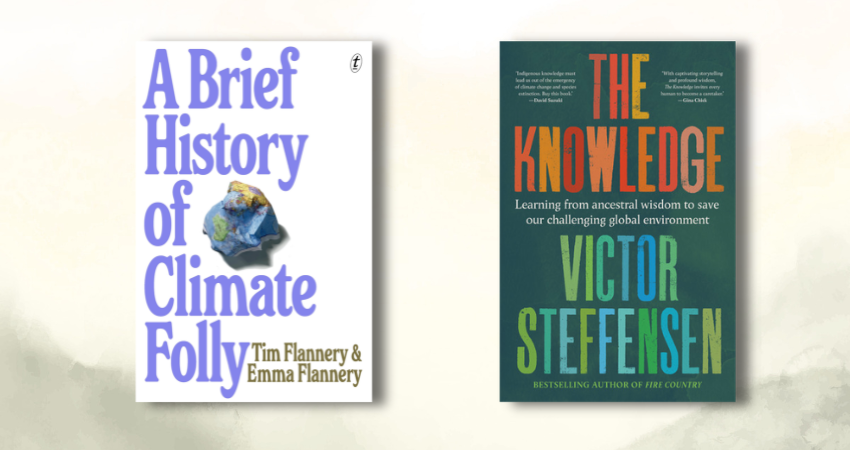
Review: A Brief History of Climate Folly, Tim Flannery and Emma Flannery, Text Publishing and The Knowledge, Victor Steffensen, Murdoch Books
As climate change accelerates, many solutions are proposed, some more radical than others. As something of a warning, Tim Flannery and his daughter Emma write about the long history of attempts to modify the climate, driven by erroneous science and sometimes bad intentions.
Perhaps unsurprisingly, science suggests dancing naked outdoors doesn’t produce rain. But there are more scientifically proven ways to change the weather, and we are at the tail end of one giant global, unintentional experiment.
Ironically, though, for much of the earlier twentieth century, scientists and politicians were concocting schemes to warm the planet, which they saw as a good thing. The warming effects of fossil fuels had already been surmised in the nineteenth century, but this was seen as a counter to what was perceived to be a potentially threatening return to an ice age. One American ‘expert’ said that we should burn as much coal as possible to make the Earth warmer and so increase arable land.
It is no surprise that snake oil salesmen in the nineteenth century were promising to bring rain for a fee. Australian Frank Melbourne made and released a gas (its recipe a commercial secret) that ‘guaranteed’ rain before the week was up. He admitted later it was a fraud but apparently regarded gullible farmers as fair game. By the twentieth century there were no less lunatic schemes, but they bore the imprimatur of science of the time.
In the twentieth century, the Russians were at the forefront of Earth systems science, as well as hubristic. They dreamed of the removal of Greenland’s ice sheet and redirecting ocean currents and Siberian rivers to warm Russia. In America, the head of the US Weather Bureau suggested using nuclear weapons to destroy Arctic ice. One American academic even suggested blowing up the moon. (Future generations may see digging up and burning millions of years’ worth of fossil fuels in a century as equally folly-filled.)
Other schemes included damming the Strait of Gibraltar, flooding the Sahara and turning Australia’s rivers inland. New Orleans is an example of geoengineering that was undertaken but has backfired. The promise of cloud seeding hasn’t materialised, and it may spread harmful substances across the land.
Some of the authors’ examples are not ‘climate folly’ exactly. Rather, they are environmental folly, but the message is clear: systems are linked and geoengineering often has disastrous consequences, often driven by greed rather than altruism.
This makes their cautious insistence that we must try other technical solutions interesting – strange, even. They argue that the climate is warming faster than anticipated and we must rapidly turn to radical solutions. These may include such possible follies as putting plastic blankets over glaciers to reflect more sunlight. Despite listing all the problems with current proposals, they argue it is ‘logical’ to try geoengineering in the face of the crisis of climate change.
Another option is to prioritise traditional knowledge, which the Intergovernmental Panel on Climate Change has recently declared is inseparable from attempts to moderate climate change, but which is still treated in tokenistic fashion by our governments. Victor Steffensen is one practitioner of traditional knowledge who argues that climate change is not the biggest problem. Climate change is, of course, a disaster, but we are here because of the deeper problem of extractive attitudes to the natural world and the marginalisation of Indigenous cultures and traditional knowledge.
Steffensen’s first book was about traditional fire management in Australia; here, he goes wider to argue for the benefits of traditional land management, even if much of the material is focussed on his own expertise (which takes him to Canada to teach cultural burning). You couldn’t get a more eloquent yet down-to-earth argument about where we have gone wrong and how we can right things.
This is a way of working that benefits land and people – a win-win – unlike a modern mentality that shuts people out of Nature by idolising it as wilderness. Wilderness is a Western term that suggests Nature is best when people are excluded (and has been used to kick Indigenous peoples off their traditional lands).
One result of this mentality is that the Australian public is somewhat in awe of the ‘bush’, but also afraid of it. Every summer we see what Steffensen calls a paramilitary operation, as firefighters (note the terminology) go into battle against what Nature throws at us. Traditional knowledge, in contrast, sees the two – people and Nature – as inseparable, in symbiosis. (This is also being recognised in places like California, hit recently by megafires but whose indigenous Karuk tribe used to practice cultural burning.)
To read Steffensen’s commentary on fire management is to slowly understand in increasing detail the depth of traditional care of the land – Indigenous people have tended the land like a garden, where plants thrive but individual species are not allowed to dominate. You can then see his frustration when the garden is not tended and falls into disrepair. He is frustrated at being stymied by officials, when he knows how and when to burn, only to watch non-Indigenous national parks staff do one-size-fits-all burns that get out of control, part of a long history of mismanagement by non-Indigenous people.

Traditional knowledge is not just a static thing – something practised by the ancestors and potentially outdated. It is a tight association of people and their environment that adapts, attuned to constant shifts. Steffensen writes about how cultural burns are practised at different times, depending on the current conditions. He describes shifting burn times to deal with sick country, then shifting back to regular timing as country recovers.
There is also an ethical side to this, of course, and traditional knowledge emphasises that Nature has limits, so in our dealings with it, we should respect those limits, listen to the advice of Elders, and think about what we can give to the land, rather than what we can get out of it. This contrasts with a Western view that often focusses on what we can do, rather than what we should do.
Nick Mattiske blogs on books at coburgreviewofbooks.wordpress.com and is the illustrator of Thoughts That Feel So Big.