

For decades, the singularity belonged to works of science fiction.
It has been described as the moment when artificial intelligence would become smarter than its creators, begin improving itself, and set humanity on a path that no one could predict. It was the premise behind films like The Matrix, Terminator, Transcendence and countless Star Trek episodes. It was the warning uttered by futurists and novelists alike: one day, we may no longer be the smartest beings on Earth.
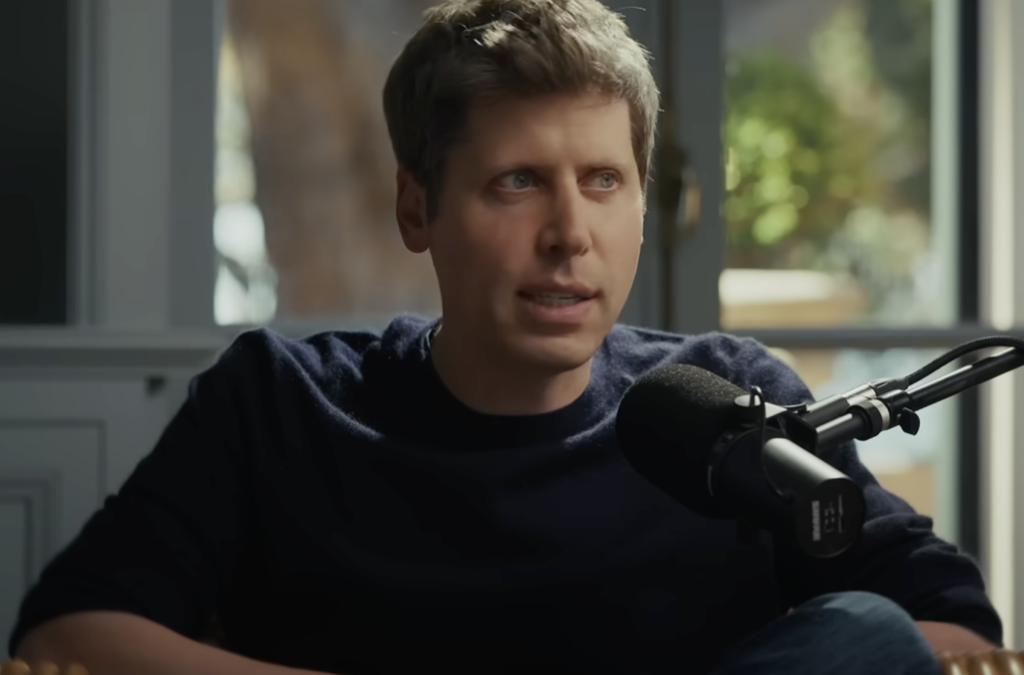
In July, OpenAI CEO Sam Altman suggested that day has already arrived.
Speaking on the Relentless podcast later, Altman remarked, “We’re now, like, in the singularity,” describing it as the moment he had spent his life anticipating and one that he believes will be “hugely positive” for humanity. He argues that AI systems are already capable of amplifying human intelligence and contributing to their own development, even if the change feels less dramatic than science fiction promised.
It’s a remarkable statement. Not simply because of who said it, but because it asks us to reconsider where we are in history. If Altman is right, then we are no longer preparing for the age of AI, we are living in it.
The singularity has always been difficult to define. The mathematician and science fiction writer Vernor Vinge popularised the term in the 1990s. Inventor Ray Kurzweil later predicted it would arrive around 2045. Both imagined a point where artificial intelligence would become capable of improving itself faster than humans could understand or control.
After that, history would become unpredictable and that uncertainty is why the concept borrowed its name from astrophysics. Just as a black hole’s singularity marks the point beyond which our understanding of physics breaks down, the technological singularity represents the point where our understanding of civilisation itself may no longer apply.
Until recently, this all sounded wonderfully implausible and the work of speculative futurists, today it feels strangely familiar.
Millions of people now use AI every day to write, research, design, code and create. Scientists are accelerating discoveries with machine learning. Businesses are restructuring entire industries around AI agents. Students are learning alongside digital tutors. Software increasingly writes software.
The future did not arrive with killer robots, but with one prompt at a time.
Altman’s declaration has also been met with scepticism. Many AI researchers argue that today’s systems are extraordinarily capable but are not yet truly self-improving in the recursive way the original singularity imagined. Human engineers still design, train and evaluate these models. Progress remains dependent on people, computing power and enormous investment rather than autonomous machine evolution.
That distinction matters because rapid progress is not necessarily the same thing as crossing an irreversible threshold.
Are we asking the wrong question?
Maybe the more important issue isn’t whether the singularity has technically arrived. Perhaps it is whether society has already crossed a cultural singularity. Our institutions certainly behave as though something fundamental has changed.
Governments are rewriting laws. Universities are redesigning assessment and in some cases giving up on the fight to spot the use of AI. Our entire workforce may change and whether or not we’ve reached the singularity in computer science, we may already be living through one in civilisation.
Looking back, the great science fiction stories weren’t primarily interested in technology. They were interested in the ways human interacted with it.
Star Trek imagined replicators, warp drives and sentient computers, yet its central question was always whether humanity’s moral development could keep pace with its technological development.
Blade Runner wasn’t really about artificial humans, it was about what makes someone human. Even The Matrix asked whether people would willingly surrender reality for comfort and convenience.
Science fiction has always functioned as moral imagination by using tomorrow to ask difficult questions about today.
Perhaps that’s why so many of its predictions now feel uncannily relevant. It wasn’t predicting specific technologies. It was anticipating the ethical dilemmas they would create.
Artificial intelligence is not inherently good or evil. Like every powerful technology before it, it amplifies what already exists within us.
It can accelerate medical breakthroughs or mass surveillance, it will definitely democratise education but it will also deepen inequality.
Interestingly, Altman himself acknowledged this tension during the same podcast, warning that one of his greatest concerns is not AI itself but the concentration of AI power in the hands of a small number of companies or governments. He described the coming choice as one between liberty and authoritarianism.
That may prove to be the defining ethical question of our generation.
Technology should always be judged by that standard and we should be asking questions. Does it help people become more fully human? Does it strengthen community? Does it protect the vulnerable? Does it distribute opportunity fairly? Or does it simply concentrate power?
These are not technical questions, but if at the moment the answers to some of those questions is “no”, this should give us pause. Because the questions it throws up are profoundly moral ones.
If AI becomes the most powerful tool humanity has ever created, then the conversation cannot remain confined to engineers and venture capitalists.
Theologians need to be there. Philosophers need to be there. Artists need to be there. Teachers, nurses, community workers and ordinary citizens need to be there too, because the future of AI is ultimately the future of humanity.
Perhaps the biggest surprise about the singularity is not that it may have arrived but that life still feels surprisingly ordinary. The deepest human questions remain stubbornly resistant to automation.
Science fiction imagined that the defining question would be whether machines become like humans. Will humans continue to become fully human?
That’s the challenge before us.
Whether or not Sam Altman is correct about the singularity, one thing seems increasingly clear. We have entered a new chapter in human history. The stories that once filled cinema screens and dog-eared paperbacks are becoming part of public policy, workplace conversations and everyday life.
Science fiction has, in many respects, come to pass.
Now comes the harder part. Not building more intelligent machines, but becoming wiser people.
Follow Adrian Drayton on his Substack – The Long Conversation – where he writes about faith, culture and media and the questions shaping our common life.