


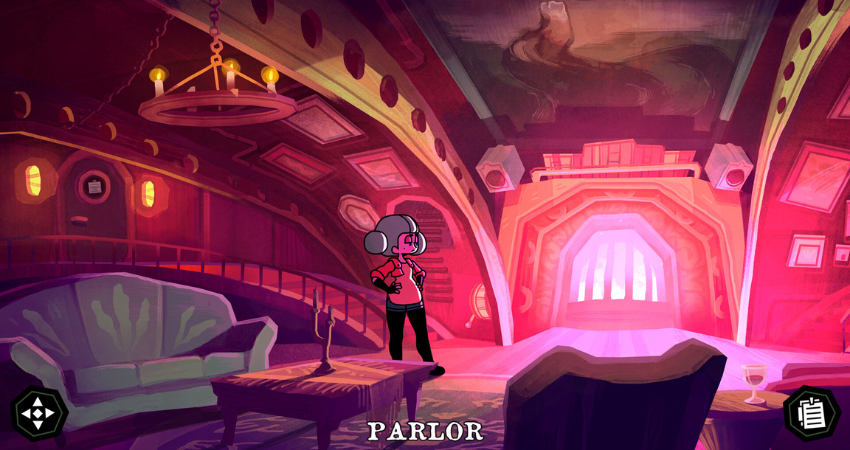
The older I get, and the longer my list of unfinished games grows, the more I appreciate a small, contained experience. The Mermaid’s Mask is set almost entirely onboard a particularly homely submarine (one with a particularly mishmash design aesthetic) and sets you up with a relatively straightforward task. Tsub’s captain, Magnus Mortuga, has been murdered, found dead inside a locked room with a cut throat and no witnesses, and you need to uncover the culprit.
If the set-up sounds familiar, it’s possible you’ve played the game’s predecessor, Tangle Tower, released in 2019. This is, in fact, the third game in the Detective Grimoire series, where the eponymous detective and his investigative partner Sally solve murders. The mechanics of The Mermaid’s Mask aren’t so different from the previous games: you jump from room to room, inspecting your environments to uncover both clues and puzzles, while questioning the ship’s inhabitants to see what they have to say for themselves. It’s fairly straightforward in action,, but the real fun comes in talking to these characters, questioning them until you start to form a better picture of what happened onboard the vessel.
Everyone on board has something to hide, whether it’s a personal secret or something that ties them more directly to the crime, and across the ten hours it took me to reach the credits I became extremely well acquainted with them all. The cast here is excellent by every metric – colourfully drawn and well-animated, brilliantly voice acted, and well-written. Every character even comes with their own bespoke music that plays as you question them, and the level of depth and detail that has gone into fleshing them out is unreal.
The interlocking nature of these characters allows for some fun, complex characterisation. An actor is visiting the sub alongside the author of the book his first major role is adapted from as he writes the sequel; a “dream scientist” works closely with a magician whose illusions may reveal more than she realises; a newly-minted teenage captain is sending ripples through the ship, the crew divided on whether she should be trusted or not. Every single character has a unique, fully voice-acted reaction to all 45 pieces of evidence you can collect and present to them, which is an uncommon level of depth for this sort of game.
There are also puzzles hidden throughout the ship, and solving them is essential to solving the mystery. These puzzles are generally straightforward and isolated from the rest of the experience, requiring that you move pieces around on a board or device until you find the right combination based on the information provided. Few of them took me longer than about five minutes to solve, especially since the generous hint system pointed me in the right direction if I submitted the wrong answer a few times. These puzzles might not make you twist your brain into new shapes, but they’re enjoyable and clever, and a good way of making you feel like you’re solving your way through the mystery.
Speaking of the mystery – it’s a good one. The case of Mortuga’s ill-fated final voyage reveals itself as a rich tapestry, one with a hard, definitive solution. The revelations don’t necessarily fly thick and fast, though. The nature of the progression model means that there were stretches of the game where I was simply showing every item to every character, until I started using the game’s hint system to see exactly what I should be showing to who. The game’s middle section was, for me, somewhat saggy as a result, like a waterlogged wooden chest that was full of gold, but required a lot of time and effort to pry open.
Thankfully, the game breaks things up with its “suspicion” sequences, where you get to the bottom of each character’s secrets through a series of reveals. The gameplay shifts in these sequences, stringing together fill-in-the-blanks conversations with more involved examinations of your evidence, and I found that while a few sequences stumped me it was always possible to brute-force through them by simply presenting every piece of evidence until I eventually succeeded. This can take a little bit of wind out of the game’s sails – fumbling to a solution is not as satisfying as being made to solve the case – but it’s more enjoyable if you take your time to really examine and think about each piece of evidence until you realise the right choice.

Perhaps most crucially for a mystery, The Mermaid’s Mask wraps up in a very satisfying way. Without spoiling anything, it’s a much better ending than Tangle Tower, easier to parse and more revelatory by its nature. This game is dripping with personality, and made with clear love – it’s the kind of game I can imagine replaying in a decade, once enough time has passed for me to forget the mystery’s solution.
The Mermaid’s Mask is available on PC, PlayStation 5 and Nintendo Switch 1 & 2. A review copy for Switch 2 was provided for this review.
James O’Connor has been writing about games since 2008. He is the author of Untitled Goose Game for Boss Fight Books.