

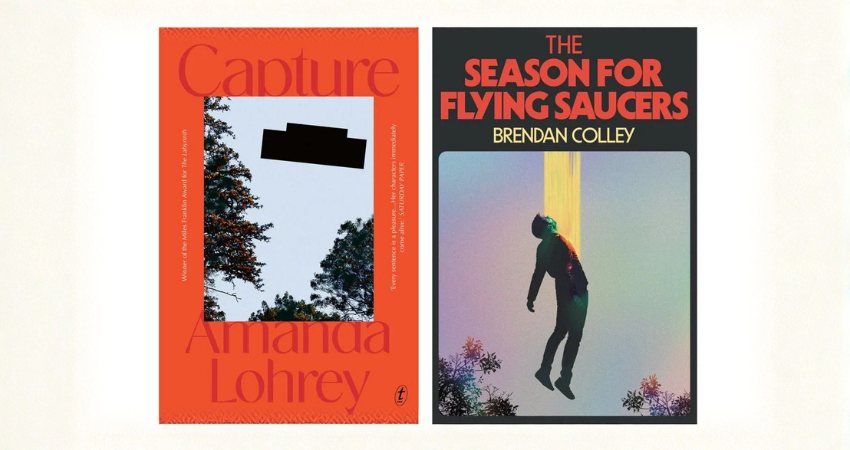
Review: The Season for Flying Saucers, Brendan Colley, Transit Lounge and Capture, Amanda Lohrey, Text
Tasmania has a history of UFO sightings. Brendan Colley uses these events as inspiration for his offbeat but warm second novel, in the deadpan absurdist suburban vein of the fiction of fellow Australian authors Wayne Macauley or Shaun Prescott, while fellow Tasmanian Amanda Lohrey offers a novel about alien abductions and the modern search for meaning.
Colley’s debut revolved around a ghost train appearing in Hobart; this new one is set in an alternate present when, in summer, Hobart residents look for regularly appearing lines of light in the skies and are used to resetting their clocks, which are thrown out whenever the UFOs pass close-by. Noah is a young chef, precariously employed, and whose wife has left him. Back in 2009 bright lights descended on his house in a suburb of Hobart in the middle of the night and his father disappeared, presumed abducted by aliens. Understandably, this fractured Noah’s family, and he is estranged from his sister and mother.
Noah writes poems about aliens and abductions on his old typewriter, subsequently publishing them online where he finds likeminded folk. His poems are a way to work through the grief and puzzlement at his father’s absence. His wife, before she leaves, warns him obliquely that if he becomes obsessed with abduction, the aliens, whether they exist or not, will find him – meaning, presumably, that something happens to people when they interact, in imagination or reality, with UFOs.
Through some unfortunate events, Noah finds his sister and mother back with him in their childhood house, which is now his – or at least will be, if he can pay it off. When his wife moved out (with the furniture) the house was empty; now it’s crowded, Noah says, which is not necessarily a complaint, but an observation of how quickly circumstances can change. More weirdly, his father also turns up, though the nature of his return is somewhat mysterious. Noah becomes something of a celebrity because the citizens of Hobart are convinced aliens have bestowed on the family special powers and that there is a possibility a UFO will return to the house.
In Amanda Lohrey’s book, a psychiatrist, Jim, takes on a research project interviewing alien abductees (or ‘experiencers’). He thinks it will be a ‘harmless’ distraction, while his wife worries it will be ‘quixotic’, bad for his reputation, and that there is a chance he will follow his interviewees down a rabbit hole.
Some experiencers have vivid recollections of their abductions; others simply wake with no explanation for lost time and only a vague sense of otherworldly presences; some are dumbfounded, some feel they have been given the gift of clarity. As a psychiatrist, Jim investigates the alternatives to literal abduction: compensation for a lack in experiencers’ lives, unconscious recognition of the harm our species is doing, a need to feel privileged in some way, simple narcissism. Beyond this, he is searching for a unifying theory explaining such delusions.
Or are they delusions? The book also touches on how culture defines disorders and how those definitions shift over time (‘hysteria’ and atheism being two good examples). Could experiencers be telling the truth, in one way or another?
The book is narrated in an almost-formal, academic tone, and it is obvious Lohrey has done her research, both about alleged abductions, psychiatry and the existential questions such accounts raise. In his search for answers, Jim talks to a theologian on campus, something of a caricature of a David Bentley Hart type (bombastic, bearded), who, perhaps unsurprisingly, diagnoses the abduction phenomenon as indicative of a flailing in the middle of the whirlpool of godless modernity.
Colley’s book finds sympathy between abductions and explorations of home: how ‘home’ is a complicated idea and how we long to be a part of ‘something bigger than ourselves’, as the writer of a UFO newsletter prosaically puts it. In Capture, one experiencer is convinced a UFO is home and the aliens are his true family. In Colley’s book, Noah’s family are all searching for a home, but they have different ideas: his father also looks for a home in the heavens, his mother is torn between trying to reconstruct a past home and moving on.

As things get more absurd, and, frankly, a little confusing, Noah and his sister come to some conclusions about families, what you choose, what you don’t, what is an imposition and what is a gift. He contemplates the relation of happiness to acceptance. In the midst of the craziness, Noah’s neighbour, a prepper, suggests to Noah that ‘we see things more clearly only after they fall apart.’
Nick Mattiske blogs on books at coburgreviewofbooks.wordpress.com and is the illustrator of Thoughts That Feel So Big.