

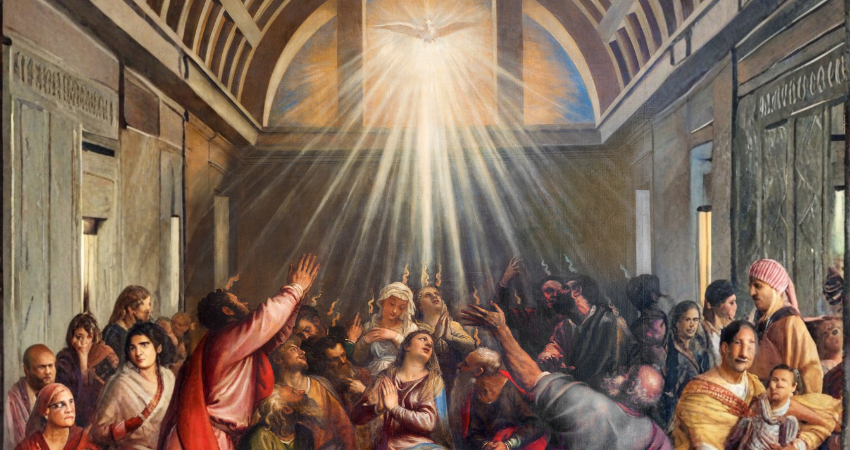
Following Pentecost, the liturgical calendar moves us into Ordinary Time: an ordered sequence of weeks between the major feast days of the Christian year which give Christian communities the opportunity to reflect on the ongoing work of the Holy Spirit, to embody the mission of Jesus, and to grow in our discipleship.
7 June – Pentecost 2
Genesis 12:1-9, Psalm 33:1-12, Romans 4:13-25, Matthew 9:9-13,18-26
Ordinary Time explores our Spirit-led call into God’s future.
Genesis frames this as a summons into holy unsettlement in which Abram leaves behind land, kinship structures, and inherited security for an as-yet-unseen promise from God. Paul insists that this promise is not a prize for the deserving, but a grace that creates a people sustained by God’s faithful presence.
Thus, Jesus’ embodies God’s desire for mercy over sacrifice in 1) his table fellowship with tax collectors and “sinners” and 2) healings that cross boundaries of status, gendered vulnerability, and ritual expectation.
A liberation lens points to God’s promises as public, and to blessing as the disruptive vocation of challenging systems that determine who is “clean”, credible, or welcome at the table. Discipleship requires movement from certainty, status, and gatekeeping to practices of mercy in Yahweh’s strange economy of grace where Jesus’ touch undoes deathly social scripts and restores dignity to bodies long written off.
14 June – Pentecost 3
Genesis 18:1-15, (21:1-7); Psalm 116:1-2,12-19; Romans 5:1-8; Matthew 9:35-10:8, (9-23)
Hospitality becomes holy work as Abraham and Sarah offer welcome to weary strangers through concrete gifts of water, bread, shade, and attentive presence. Yet, the good news of God’s promise is hard for Sarah to hear in the reality of her “written off” body; her laughter holds together desire, disappointment, and the vulnerability of long waiting for unanswered prayers.
Meanwhile, Paul proclaims a peace grounded in Christ’s love for us “while we were still weak,” the Psalmist pours out his gratitude to Yahweh who has “rescued me from death, my eyes from tears, and my feet from stumbling,” and Jesus is so moved with compassion for the “harassed and dejected” crowds that he sends his disciples out to visit, listen, proclaim good news, and heal while making themselves dependent on the welcome of community for food and shelter.
God meets people at the margins of possibility – barrenness, weakness, hopelessness- to form mission-shaped communities through shared tables, peace, risk, and even the laughter that is part-hope and part-despair.
21 June – Pentecost 4
Genesis 21:8-21; Psalm 86: 1-10,16-17; Romans 6:1b-11; Matthew 10:24-39
In texts that refuse easy reading, Hagar and Ishmael are expelled into the wilderness by household rivalry and power, confronting how enslaved peoples and their children are used and discarded within patriarchal culture.
The Psalm’s plea for pity holds space for honest prayer when survival is uncertain.
Paul’s baptismal imagination names a break with the death-dealing systems that have enslaved us: as we are joined to Christ’s death, we are raised to a new allegiance which puts an end to the ruling powers of our own lives.
Jesus prepares his disciples for the resistance that they will encounter in responding to his “take up the cross” call – both externally against their solidarity with the marginalised, and, internally, as temptation to flee the consequences of costly truth-telling.
This is the long obedience of liberation in which we learn to see the God who sees, choose solidarity over self-protection, and trust that new life is found where the world says, “There is no water.”
28 June – Pentecost 5
Genesis 22:1-14; Psalm 13; Romans 6:12-23; Matthew 10:40-42
One of Scripture’s most disturbing narratives (the binding and near sacrifice of Isaac) meets lament amid anxious waiting, a baptismal exhortation to resist sin’s dominion, and Jesus’ teaching on receiving “little ones.” Together, they ask what kind of God we proclaim, what kind of obedience we commend, and what kind of community discipleship produces.
Genesis 22 has multiple interpretations but must not be domesticated into an endorsement of unquestioning obedience. The story itself turns on the angel’s “Do not lay your hand on the boy” and the provision of an alternative. Any reading that sanctifies intended harm endangers the vulnerable, especially those already subject to coercive religious, domestic, or institutional power.
Discipleship here is about discernment: recognising voices that sound “religious” but produce death, and choosing, instead, practices that protect life. We should name safeguarding as gospel work, honour the “how long” protest of our hearts as prayer, and measure worship by its mercy. Matthew’s “cold water” image invites small, consistent acts as resistance to cultures of harm.
These Lectionary Reflections were prepared by Rev. Yvonne Ghavalas