

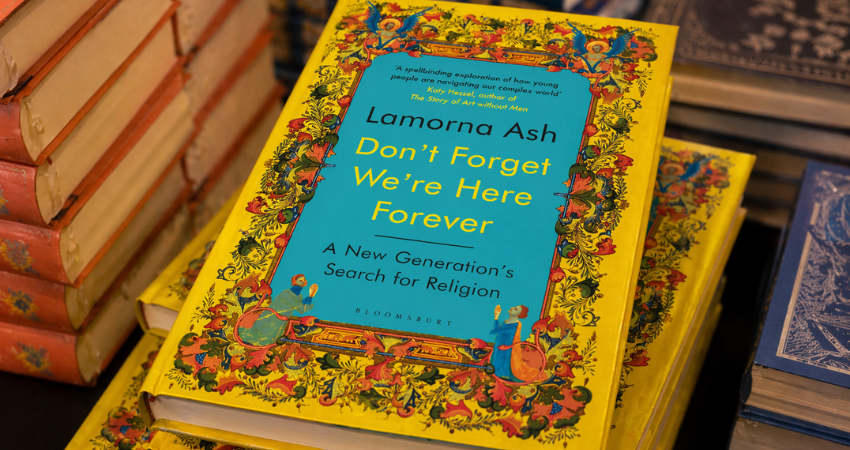
Review: Don’t Forget We’re Here Forever, Lamorna Ash, Bloomsbury
We hear much about simultaneous decline and revival in Western Christianity but there isn’t another book on contemporary Christianity quite like Lamorna Ash’s. The writer of a previous book on the Cornish fishing industry, in this new book she likewise takes a very personal approach, immersing herself and narrating her own story of discovery while also relating the stories of others, to map the shifting currents.
She drives an old Corolla around Britain, interviewing parishioners, seekers and apostates. With a starting point of only bare, childhood familiarity with Anglicanism, her narrative runs from, initially, her encounters with evangelical Christians through to those who have found alternate forms of Christianity that cater to their sexual orientation, their doubts, even their unbelief, and to her own explorations of religious practice, including at religious retreats run by Jesuits and nuns, while wondering what it is all about. At the very least, Ash’s book is an appeal to secular readers to not dismiss religion, seeing as most of the world subscribes to one or another. But it is also an invitation for those within churches to think expansively.
In Britain, as elsewhere, and mirroring wider trends in society, evangelical and Pentecostal denominations are growing, appealing to those who want certainty, enthusiasm and an alternative to what seems to be a hollow, meaningless contemporary secularity. In contrast, more liberal churches are declining, with one academic arguing that liberal churches do themselves out of a job by eschewing rigidity and intense indoctrination and adopting a generally easy-going attitude, which doesn’t get bums on seats in the same way that evangelical churches or fiercely Orthodox Christianity does. (Of course, pure numbers aren’t the whole story.)
Ash steps in to test the waters. At first her ‘research’ is prickly, as she confronts young evangelicals who seem naively black and white in their thinking, her prickliness informed by her familiarity with those excluded or traumatised by church. She attends a Christianity Explored course (a rival to Nicky Gumbel’s Alpha) and interviews its founder. She finds the course itself has too much focus on certainty, informed by a conservative literalism, and that it is, she writes, as if the outside world doesn’t get a look in, in any meaningful, specific way. She feels the point of the course is not to explore but to quash dissent to the point of conformity.
Her book title (borrowed from The Simpsons?) refers to promises made to young Christians reinforcing this certainty, though some of the evangelical rigidity masks fragility, ignorance and intolerance. Ash is more interested in honest expressions of instability and in an understanding of how, historically, spiritual expression often entails puzzlement and attempts to express the inexpressible.
The view of contemporary Christianity is inevitably complicated. Her research occurs to the bemusement of her young, urbanised friends who, she writes, proclaim themselves atheists without really knowing what Christian faith entails. But she notes that younger people are generally – there are exceptions, of course – tolerant and so open to spirituality, not to mention the supernatural, and they are, also, to the consternation of conservatives, more likely to shop around.
Along the journey, her attitude to those she disagrees with gradually becomes more open, and there is a generous self-examining side to her narrative. At one point she talks to a YWAM missionary, who admits to asking potential Hindu converts about their gods only so the missionary can trump them with Jesus. While Ash laments this lack of honesty, later she admits she wasn’t taking the missionary’s God seriously either.
Initially annoyed at before/after testimonies, she recognises that there are genuine transformations, and that they are not just quirks of Pentecostalism but are there in the gospels, all throughout. She writes that when she is annoyed at the narrowness of some believers she can return to the sacred texts themselves and see the surprising, enlivening effect Jesus has on his contemporaries.

She returns repeatedly to the biblical story of Jacob wrestling the angel to symbolise the religious struggle, including her own. She writes that it is almost naïve to think one can research how people are converted or feel the presence of God – how it feels to be religious – without wondering about one’s own feelings and perspectives. So, she finds herself repeatedly in Quaker meetings where, after the Pentecostal services, she writes, it is refreshing to not be constantly asked if she can be prayed over. She meets an atheist Quaker (a common enough position, apparently) who likes the equality, insistence on social justice and wrestling with ideas, all within a framework that values religious silence and insists that the silence should not be broken unless someone has wrestled with what they feel called to say.
Nick Mattiske blogs on books at coburgreviewofbooks.wordpress.com and is the illustrator of Thoughts That Feel So Big.