

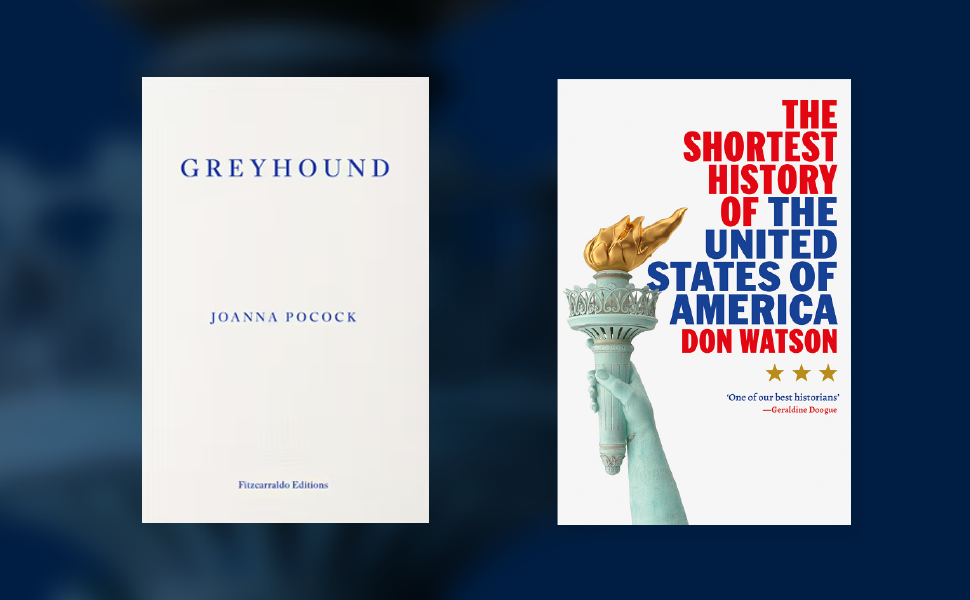
Reviews: The Shortest History of the United States, Don Watson, Black Inc. | Greyhound, Joanna Pocock, Fitzcarraldo
With the USA descending into fascism and international aggression, and Trump violently suppressing dissent and enriching his own coffers, one of the questions is whether this current iteration is a unique aberration or whether Trump is, as Don Watson puts it, the ‘natural offspring’ of American self-interest. But, of course, what America is at heart is not just a question for today, but a perennial question.
Other histories of the United States, of which there are many, pose this question. David Reynolds calls American liberty a ‘paradox’ and ‘ambiguous’. James West Davidson, an author, like Watson, of a short history, asks how a nation could ‘proclaim freedom’ when the country had thousands of slaves, Native Americans were treated horribly, and the vote was denied to women. (The short answer is that the white men who proclaimed the importance of freedom thought it only applied to them.) Watson says, quoting poet Walt Whitman, that America contains multitudes, and why wouldn’t it, being so big? But these multitudes also look like opposites, and these fundamental tensions are part of what makes it intriguing. (Watson manages to keep the tensions and ambiguities to the fore while running a brisk narrative.)
Watson starts with the January 6 mayhem (‘attempted coup’ seems to give them too much credit), where a rabble, spurred on by Trump and beholden to a narrow vision of the country, tried to save democracy by undermining it. Freedom seems like the bedfellow of democracy, but there is a long American history of Americans denying freedom to fellow Americans, both at the top and the bottom. The so-called Founding Fathers were suspicious of the people (sometimes for good reason), as was Richard Nixon, bypassing the congress to consolidate power even while he praised the ‘silent majority’; after desegregation, white Southerners did everything they could to deny Black Americans the vote.
These ambiguities play out internationally too, where the light on the hill was sometimes the flash of cannon fire. After World War II Truman talked of spreading democracy, which was really just an excuse for violently securing American interest. The American government has swung between (as Trump does) isolationism and international meddling. Even within the latter, you could have Nixon and Kissinger bombing the hell out of Vietnam and then making peaceful overtures to China and the USSR, which Reagan tried ten years later.
Some of this is inevitable, as Watson suggests the constitution set up ‘never-ending argument[s]’ about how it should be interpreted. (Even within this there are arguments over whether the constitution is a ‘living document’ or whether it should retain its ‘original’ meaning.) He notes, for example, that for all of Jefferson’s talk of ‘natural’ rights, he never applied them to Native Americans. And though there were instances of handwringing over the plight of the Indigenous inhabitants, the new government paid new Americans to kill Native Americans, including women and children.
The clash of high ideals and grubbier motives lies at the heart of the Revolution too. The official, schoolbook history suggests that the revolutionaries were aggrieved at the lack of proper political representation and an overbearing (and remote) British government. A more cynical view is that a bunch of wealthy white men wanted unfettered capitalism and unrestricted access to Native American lands to exploit. Both are likely true, as freedom meant different things to different people, and, it must be noted, the revolutionaries argued fiercely amongst themselves.
Freedom was such an important notion for the first colonists, explains Watson, because it meant freedom from poverty and religious persecution. It has become normal to criticise the dour Puritans – Watson notes they also brought ‘social justice, education, communitarianism and democracy’, though, ironically, Puritan freedom came at the expense of local North American populations, whose lands the Puritans argued had been divinely gifted to them.
Some of the Puritans decided the new colony wasn’t free enough, and they decided to leave and form their own – or it was decided for them. These schisms have been echoed around the world and through American history, as Christians have repeatedly broken free of shackles only to apply them to someone else.
Yet since the 1600s, there has always been a place for dissenters within America, allowing for the explosion of various religious expressions, Christian, Jewish or otherwise. At the same time, there has been intolerance – towards Native American and folk culture, Muslims, and those who choose no religion. And if the latter went with communism, even though communism doesn’t mandate atheism, even worse – the early church being an example of communitarianism that Americans have wilfully ignored because it clashed with the idea of free enterprise.
The importance of money has always clashed with more Christian ideals, though Americans have done their best to square these incompatible preoccupations. Tycoons may have taken on philanthropy to varying degrees, but they lived by the creed of survival of the fittest and grew wealthy through the exploitation of human and nature alike, believing government and unions only hindered, just like the billionaire libertarians today.
On the other hand, the Second Great Awakening happened as geographic expansion happened, as religious radicals recognised the lure of lucre. This revival was typically individualistic in terms of salvation, but Watson notes how there was also a suspicion of self-interest and an emphasis on charity, and so a great movement of volunteer organisations emerged – a community orientation that today still co-exists and competes with more capitalistic thinking. This may be a glimmer of hope amongst darker days.
If Watson’s is a view from the air, so to speak, Joanna Pocock’s book is a view from the ground – literally a view through the windows of a Greyhound bus. And it is a perfect complement to Watson’s book, though largely a picture of decline.
In the book, Pocock retraces a bus trip she took two decades ago, down the middle of America, through what is often termed its heartland, but where America is suffering acute symptoms from what might be termed a heart condition. While the book is another version of the view of/from America, a microcosm standing in for the whole, she says that on her trip no-one mentions Trump – Washington and Florida are a world away from more local and pressing issues, from the day-to-day grind of survival. But that such an immediate focus is necessary also says something about contemporary America.
She describes a place of failing services and vast inequalities, more desperation and less community, reasons why America is clearly not, as Americans continue to claim, the greatest country on Earth. And there is something Baudrillardian in the fact that, to Americans, a place can be really crappy but can be redeemed by draping an American flag over it.
This Baudrillardism gets very real when, Pocock notices, people are in bubbles of screens and headphones, in contrast to twenty years ago when there seemed to be more of a community spirit to these bus trips. Additionally, the services previously provided by humans have been relegated to websites and apps, which don’t provide much in the way of service at all.
Perhaps inevitably, there are encounters with crazy people with hints of wisdom. One guy tells her that ‘Karens’ are the only ones who care. Here in the heartland, a distrust of government is informed by omnipresent government failures to provide – it is up to small communities to self-organise. People who are presented as backward-looking in more progressive circles understandably cling to the past because the past was better in small towns (for most at least) and relentless change is inevitably for the worse.
The buses take her through areas of neglect and destruction, and areas where abundance contrasts with the costs to nature – she writes about the Ford plant in Michigan where the company boasts about its green credentials, but where the river remains contaminated. She contrasts the revitalisation of Detroit’s centre, through the rise of community ‘urban farms’, with the mega-feedlots of Texas and the madness of water use in desert cities like Las Vegas.
It is hard to escape the legacy of Henry Ford – Pocock writes that it is impossible to imagine America without cars. But freeways are built on white flight and the demolition of African American neighbourhoods; one observer in 1934 called the Ford plant a nightmare because, amongst other things it was so obviously a corroder of small-town community. Ford enabled mass mobility but there was a cost: the freedom entailed anonymity. Observing this from another angle, Steinbeck commented on the restlessness in the American character. Travel is lauded in America, as metaphor and literally, yet Pocock concludes that the ‘ecology of place’ is better.
Along the way, she notes that the people like her who choose to travel by public transport are increasingly rarer, as one is in close proximity to those who can’t afford to or who can’t drive, with all the attendant issues. There are lost drivers, missing passengers, broken buses, women crying, pervasive drugs, a lack of services with no-one to complain to, money having been funnelled into advertising rather than infrastructure, or just disappeared in corporate takeovers. In Phoenix, people on the margins commonly die from heatstroke, yet these are the ones who don’t have cars, a major cause of global warming. In Vegas, it seems to all pile up: water problems, nuclear waste, inequality, the vacuousness of rampant consumerism. (Henry Miller wrote that all America offered was ‘superabundant loot… recklessly plunder[ed]’, with the people under the ‘delusion’ that this was progress.)

One thousand kilometres in, Pocock feels the Greyhound line is on its last legs – a ‘failed experiment’, and so it seems is America, if all the homeless people she encounters and an indifference to their problems in the midst of shiny excess are indicative of the state of the union. In Vegas, she witnesses the substantial remains of the world’s largest cake – made in celebration of something or other – being fed to pigs, which is about as much symbolism as you need.
Nick Mattiske blogs on books at coburgreviewofbooks.wordpress.com and is the illustrator of Thoughts That Feel So Big.