

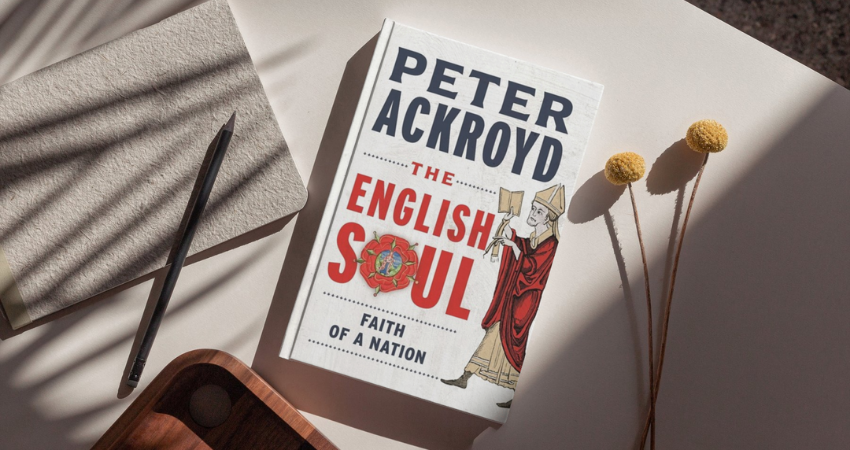
Reviews: The English Soul: Faith of a Nation, Peter Ackroyd, Reaktion
In Peter Ackroyd’s history of the English and Christianity, he emphasises a kind of pragmatic and reserved Christianity, exemplified by the Elizabethan attempt at a ‘middle way’ and the quiet country parishes of George Herbert or Ronald Blythe. As comfortable as this may seem, as in other areas of English life, pragmatism is a neighbour of eccentricity. A major theme of his book is that parishioners in English history have been continually caught between the twin tracks of high conservatism and radicalism, which toss and tumble what Ackroyd calls the ‘English soul’.
Who is radical and who is conservative is not always easily articulated and shifts throughout history. For example, Ackroyd points to young contemporary English evangelicals, who can be seen as conservative on one hand, but in their enthusiasm, unwillingness to countenance other views and suspicion of high tradition, are inheritors of eighteenth-century revivalism and Civil War radicalism. In their beliefs they align somewhat with G K Chesterton’s use of paradox: the orthodox seem radical in the pluralist, scientific age.
These shifts might be most obvious in the Reformation, where the once-established Catholicism was rejected, and Catholics became agitators and heretics. Later, Archbishop William Laud aimed for compromise, proclaiming high ritual a ‘hedge’ that protected Anglicanism from heresy. He wasn’t Catholic at all but was painted as such by his Puritan critics for rejecting predestination and for reversing the Puritan simplification of the eucharist. Although quite traditional, Laud’s acts were derided by Cromwell as ‘innovations’. John Henry Newman, in the nineteenth century, found Anglicanism not authoritarian and traditional enough, and he made a shocking conversion to Catholicism. Even fellow Catholics shunned him, thinking him a stirrer.
As elsewhere, before the Reformation, translating the Bible into the vernacular was a defiant, subversive act that would later become central to the Protestant establishment. The figure of John Wyclif has, says Ackroyd, always been controversial: was he a keeper of the faith or an agitator against church authority? Wyclif could use orthodox theology to argue for a more secular government, a Bible for the people and separating the clergy from secular wealth. Prefiguring Luther, he asserted the authority of the Bible over that of the pope. He radically challenged the thinking of the day but helped set up the idea of the monarch as the head of an English church – what would eventually become a conservative position.
The work of Wyclif and Tyndale would eventuate in the King James Bible. Although Ackroyd writes that the KJV belongs to the whole nation, he also says that its creation was as much about creating uniformity, with the monarch and established church regaining control of the vernacular scriptures, whereas the work of Wyclif and Tyndale had been a more radical democratisation of it. Protestantism became the norm, and the radicals were those who broke away from or tried to reform the now hierarchical, established church.
All hell broke loose in the Civil War, with the explosion of sects, such as Grindletonians and Muggletonians, Ranters, Levellers and Diggers, who, like the peasants in Germany, took the message of the Bible to what they thought were its logical conclusions, even if, Ackroyd reminds us, most of the English tried to go on with their usual business. The war was political, for sure, but it was also a war of religion, though the two are not easily separated in this era. Groups rose and fell, the Baptists unusual in enduring until today. The established church and sect alike would call each other heretics. Of rivalry between sects, Ackroyd writes that ‘we hate what we resemble most’. (If England is a land of Sunday roasts and mild vicars, it is also a land of burnings and radical pamphlets.)
Ackroyd sees the ‘English soul’ in the Diggers’ spiritually minded but grounded communism as much as in the more traditional aspects of Anglicanism. Throughout history there is common dissent against hierarchy, such as in the Quakers, who were instrumental in the abolition of slavery and who were notorious for their refusal to adhere to the principles of deference. We see in the Booths and the Salvos, who moved amongst the poorest neighbourhoods where few were churchgoers and where the Anglican clergy feared to tread, both a pragmatism in their social work and a radicalism in their challenge to the stratification of society.
The ossification of the established church was what John Welsey reacted against. Country vicars were sometimes wealthy from other means, and employed poor, uneducated parsons, who were held in contempt by their ‘betters’, to do their parish work. These poor clergy were no better than servants and in no place to question society’s inequalities and hypocrisies. Meanwhile, the wealthy bishops were there to ensure (hierarchical) order.
Mainstream congregations and their clergy were, said one eighteenth-century observer, neither nonbelievers nor enthusiasts. Wesley, on the other hand, was enthusiastic, aiming for a primitive Christianity that recalled the Reformation and focussed on individual salvation rather than community conformity. Revivals were as much a feature of the English landscape as the traditional churches, as would be the case in the United States, which would harbour the most radical of post-Civil War sects.
A flipside of this enthusiasm was prudery, seen in Cromwell’s government and in Wilberforce’s evangelicals, who were so successful in banning entertainment on Sundays that there were complaints in young Queen Victoria’s circle that things had got too ‘religious’. This was not elitism, though – this prudery could go hand-in-hand with an impatience for high ritual and an enthusiasm for social work.
Ackroyd writes that the English have always been more interested in morality than doctrine, though, as Ackroyd subsequently points out, the iconoclasts have been as enthusiastic as anyone. More intellectual clergy, like Rowan Williams or John Robinson, are greeted with tolerance rather than accolades, although the likes of Tom Wright or Alister McGrath (neither of whom Ackroyd mentions) can mix theological speculation with practical application. It’s probably fair to say, though, that they remain a mystery to Christmas and Easter Christians. Evangelicals may aim for the person on the street, but their goal is largely spiritual conversion, along with a narrow, more individual morality, rather than attempts at radically levelling the structures of society.

Regarding the current state of affairs, Ackroyd doesn’t have much to say about the likes of the effect of immigration and multiculturalism on English Christianity. But, continuing the twin-track theme, like a conservative, he celebrates the long history of the English church as inseparable from the English character and decries a present laxity, but, like a liberal, he pins the laxity on the wealthy using the church as simply a tool of the state and the leaders of the churches complicit in perpetuating inequality.
Nick Mattiske blogs on books at coburgreviewofbooks.wordpress.com and is the illustrator of Thoughts That Feel So Big.