

Let’s be honest, there are plenty of things that can put pressure on a family.
Money. Work. A failing marriage. The discovery that your partner has been secretly writing a novel about how unhappy they are.
And then there are dinosaurs.
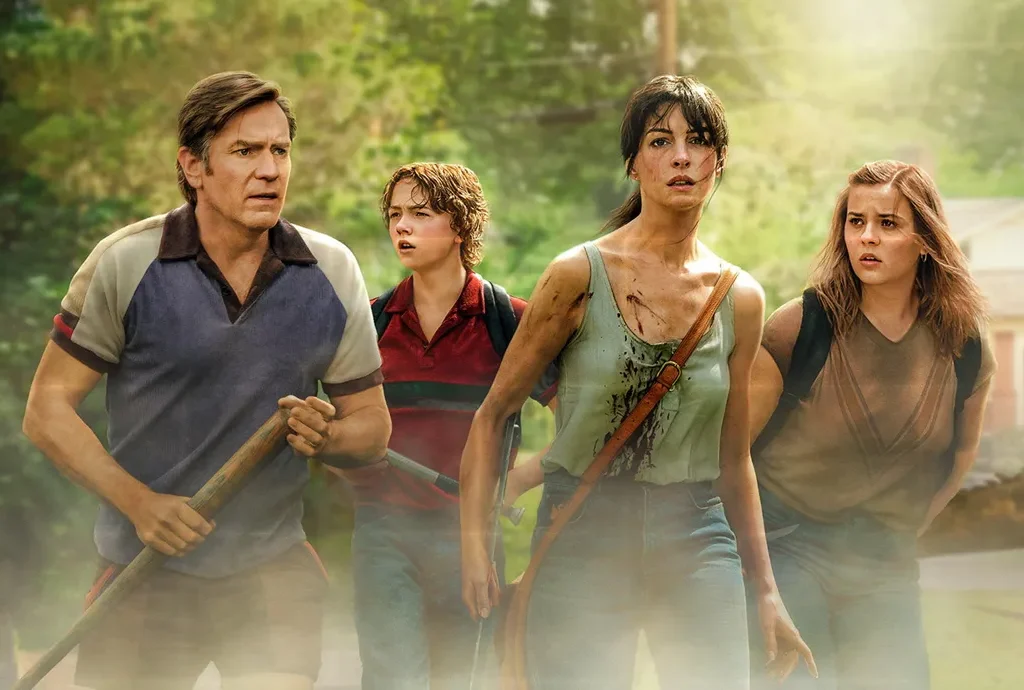
The End of Oak Street, the new film starring Anne Hathaway and Ewan McGregor, takes the familiar suburban family drama and asks the obvious question: what if, instead of going to couples therapy, the entire neighbourhood was suddenly transported to prehistoric times and you had to fend off an Allosaurus?
It might not be the most conventional approach to marriage counselling, but it does get everyone talking.
The film, written and directed by David Robert Mitchell, begins with the Platt family living a fairly ordinary suburban life in 1982. Denise, played by Hathaway, is a frustrated wife and aspiring writer. Greg, played by McGregor, is struggling with work and increasingly distant from his family. Their teenage daughter Audrey and younger son Brian have their own problems and anxieties.
In other words, they’re a perfectly normal family.
Then their street disappears from suburbia and finds itself somewhere considerably less developed. The cretaceous period.
Suddenly, your usual family argument about who forgot to take the bins out seems insignificant. Although, to be fair, I’m sure someone still forgot to take the bins out.
The film’s official synopsis describes the family’s survival as depending on them sticking together, which is perhaps the most literal interpretation of “family values” Hollywood has attempted in some time.
What makes the film interesting is that the dinosaurs aren’t really the most frightening thing happening to the Platts.
Their marriage is.
Before the neighbourhood becomes Jurassic Park in suburbia, Denise and Greg are already struggling. There’s a distance between them that neither seems quite capable of crossing. Greg is hiding the fact that he’s lost his job. Denise is retreating into her writing in their basement.
The dinosaurs simply have the bad manners to arrive at the same time.
And this is where The End of Oak Street becomes more interesting than its wonderfully ridiculous premise suggests. Because perhaps dinosaurs really are the perfect metaphor for family dynamics. Think about it.
Family life is a wild unpredictable ride.
In The End of Oak Street, the Platts discover that they can’t simply keep pretending everything is fine. The extraordinary circumstances force them to confront things they’ve been avoiding.
This is one of the oldest tricks in family drama. Put a family under extreme pressure and eventually everyone has to tell the truth. Usually this involves a terminal illness, a funeral or a wedding.
Mitchell simply thought, “What if we used dinosaurs?”
It’s actually quite efficient. Giant prehistoric predators have a way of cutting through small talk.
The film also taps into that great tradition of suburban cinema where the ordinary home becomes a place of extraordinary danger. There’s a clear affection for the Spielberg films of the 1970s and ‘80s, particularly Jaws, E.T. and Close Encounters of the Third Kind. The difference is that instead of waiting for something strange to arrive in suburbia, Mitchell takes suburbia somewhere strange.
And there is something wonderfully odd and funny about that.
We’ve spent decades watching Hollywood send ordinary people into extraordinary places. Now an ordinary suburban street has simply been picked up and dropped into prehistory.
The film’s real strength, though, is Anne Hathaway.
Denise begins the story as someone who seems emotionally exhausted by her family life. But when the dinosaurs arrive, something changes. She becomes fiercely protective of her family and surprisingly capable of dealing with the chaos around her.
There’s a delicious irony in this. Sometimes it takes the end of the world to make us take stock. And perhaps that’s why the dinosaurs work.
They’re not really the story they’re the thing that removes all the distractions, and in truth a few genuine jump scares. The film asks, “When everything familiar disappears, what matters?”
The film doesn’t always get the emotional balance right. The family drama is a little underdeveloped and its Spielberg influences are perhaps a little too obvious. But there’s something appealing about its willingness to take a completely absurd premise seriously. Because families are absurd.
We love people who drive us crazy. We occasionally want to escape from the people we would ultimately risk everything to save. And sometimes the person you think is the problem turns out to be the person you need most when the giant prehistoric reptiles arrive.
Maybe that’s the real lesson of The End of Oak Street.
You don’t really know how strong a family is until something enormous comes crashing through the front door. Although perhaps we don’t need to wait for a dinosaur.
So yes, maybe dinosaurs are the new metaphor for family dynamics.
The Tyrannosaurus is the unresolved argument in the room. The raptors are teenage children.
But underneath all the roaring, running and occasional prehistoric panic, The End of Oak Street is making a fairly old-fashioned argument.
Family isn’t about having a perfect home. It’s about what happens when the home disappears.
And if the only way to discover that is to have your suburban street transported back 65 million years, then perhaps that’s a small price to pay.
Follow Adrian Drayton on his Substack – The Long Conversation – where he writes about faith, culture and media and the questions shaping our common life.