

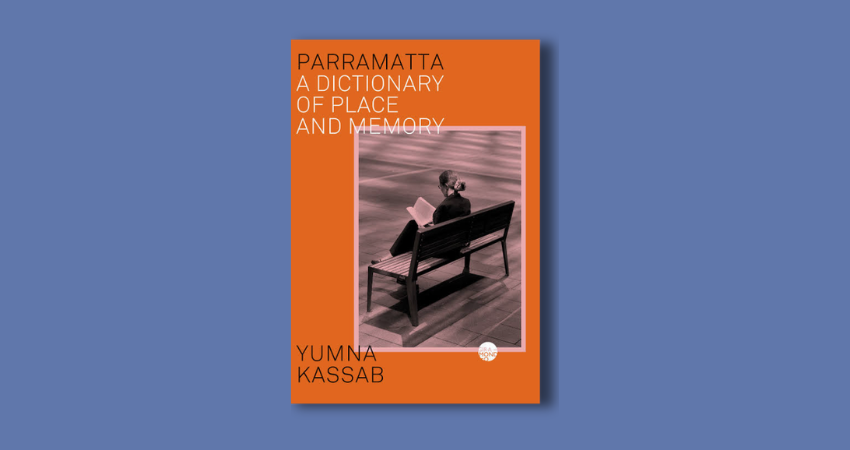
Review: Parramatta: A Dictionary of Place and Memory, Yumna Kassab, Giramondo
Yumna Kassab’s wonderfully inventive writing is marked by its increasingly fragmentary form. She says that she and her publishers argue about whether her books can be constituted as novels, considering their kaleidoscopic nature, free from the narrowness of a central viewpoint. This form, though, is well-suited to this project of a Parramatta dictionary, which proceeds as entries that are at times as short as a sentence fragment, and which are addictive, like phone scrolling.* (Indeed, this format might be well-suited to the age of short attention spans.)
The book is a grand tribute to Sydney’s second city, but it is not a conventional history or study. A dictionary, of course, usually aims for universality; here, rather, even though she says it is an exercise in ‘decentring the I’, it is also, she says, a personal view of Parramatta. She writes at one point about the ‘extensive Yumnian archive’, tongue-in-cheek.
In this, there is the idea that a community shapes the individual. We each have an individual view; we are tangled in the threads of connections. Her very first, startlingly ethical, entry is about how the elevation of the individual can lead to the ‘eternally lonely’, a fittingly cautious introduction to a book about community. Think, she seems to say, not first about your individuality, but about how community shapes you.
There is so much here – lots of sparks for thought. She has sage observations and advice on feminism, the Wanderers, Gaza, writing, the history of ideas, inequality, the Australian aversion to the divine, the history of Parramatta buildings, the necessary place of civic life, the importance of libraries. The past and present, physical and emotional, political and commercial, serious and playful intertwine. I could say that it is not a sustained burn, but there are themes that do reappear.
For Kassab, Parramatta is central, and ‘all roads can be made to lead to Parramatta’. It has, she says, all you need. She refers to it as ‘Parradise’. She is part of a cohort of writers arguing the case for the West being more than an annex to Sydney’s CBD. Partly, the book is an exercise in showing the cultural richness of Parramatta, despite she notes, the East getting more than twice the arts funding that Parramatta does.
For a writer, it might not be surprising that coffee shops feature heavily. One project might be to try the more than twenty coffee shops she mentions. There are other lists: of ingredients, names, suburbs, books. She mentions fellow Giramondo stablemates Luke Carman, Raaza Jamshed and Alexis Wright. She mentions the cemetery wanderings of Mariana Enriquez, the importance of place in the fiction of Anne Rice.
While she celebrates a Western literary culture, ethnic cultural considerations also feature. She notes the perpetual racism of mainstream Australia when it comes to Middle Eastern migrants. She writes that Australia is happy to enjoy the food but becomes suspicious of cultural particularities beyond the superficial. She argues that we still have a way to go before we can celebrate and ‘normalise’ a variety of cultures beyond one ‘Harmony’ Day a year.

The obliteration of Gaza is a background, and she is saddened and exasperated by the genocide, and subsequent indifference or attempts at justification. At one point – well, in the ‘A’ chapter – she writes that being ‘apolitical’ is a privilege not available to most people around the world. In contrast, her celebration of the culture of the West may be a counter to the intolerance and ignorance currently resurgent in Australian politics, and wider.
This is a book I will return to, I think. I want to read the books she mentions, try the coffee shops she mentions. I want to share in her enthusiasm; I want to be prompted to think about the richness our recent migrant history has bestowed upon us.
*Some of the entries in Kassab’s book can also be found on the Sydney Review of Books website.
Nick Mattiske blogs on books at coburgreviewofbooks.wordpress.com and is the illustrator of Thoughts That Feel So Big.