

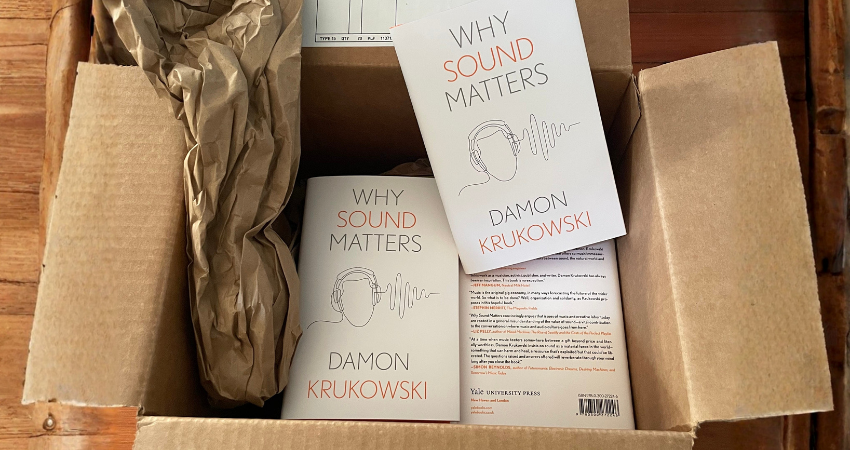
Review: Why Sounds Matters, Damon Krukowski, Yale
In the womb, we hear the outside world before we see it. Through life, music and conversation are wonders and delights. Nurses tell us – I don’t know how accurately – that our dying relatives can still hear us when they seem lost to the world.
But one of the features of modernity is noise pollution. Twenty years ago, you could wait on a train station platform without being assaulted by advertising blaring from big screens or speakers, by music or constant announcements from railway officials who assume commuters need to be ordered around like kindergarten children. At football matches, we can no longer converse between play; now any break is an excuse to blast aggressive music or fill it with inane shouting by parochial spruikers.
Damon Krukowski writes that noise pollution is not as great a concern as providing shelter, water, air and food, but sound matters, as he says, and what we hear has physical, emotional and mental effects.
The inspirational environmentalist Rachel Carson was, ironically, worried about sound disappearing from the natural world – birdsong specifically – though her concerns were not contradictory to noise pollution, just one of the many pressures on the natural world. As David George Haskell writes in his book Sounds Wild and Broken, birds in cities have to amplify their voices to be heard. And imagine being a whale or a shrimp – there is noise pollution from propellors, seismic soundings to find oil, scrapings from fishing; it is said that this is like jet planes flying over your house constantly, and in this context the theory that whales beach themselves trying to escape noise makes sense.
Krukowski is a musician (previously a drummer in an indie-pop band, now one half of a folk duo). Contrary to the stereotypical image of drummers, he is a perceptive thinker and eloquent writer. In his small book (I read it in one evening) he moves quickly from stories of noise pollution in the natural world to stories about being a soundboard operator in a folk music club in Massachusetts. Some of this is funny – he describes folk musicians wanting just one central mic on stage (as in the good ole days) but then wandering around and moving in and out of the audio mix.
His main concern, though, is the value of music in the age of streaming. We don’t have to go into detail about his economic arguments here, but his point is that in these days of resurgent fascism and tech oligarchs the labour of making music has been worryingly devalued, that online, the biggest companies work at non-human scales where music is almost value-less, but this contrasts with the value of making music in the community setting. We might add that there are correlations between streaming music and fast fashion, and similar harmful effects, on workers primarily, but also on the attitudes of consumers.
His economic argument, or political argument if you like, is that streaming companies devalue the labour of making music, claiming that making music costs very little these days, so they can make more profit; this is an update on the perennial capitalist problem of bosses devaluing labour so that the profits flow upwards.
It is certainly easier to make music these days, due to technological developments, and this reduces music-making to a hobby; musicians have a hard time making a living. Streaming companies are happy to go along with this because, counter-intuitively, the low cost of accessing music means more streaming and, for them, more money.
If this seems a long way from ocean noise pollution suddenly, he links them by suggesting that streaming companies treat music as pollution, as simply a byproduct of grabbing your attention so they can sell advertising space and mine data (as the founders of Spotify happily admit), in the same way that pollution is seen by corporations as simply the unavoidable cost of making a profit. Streaming companies’ primary concern is not enhancing listeners’ experiences of music.
Krukowski writes about Chris Watson, formerly an eighties post-punk British musician, who moved into field recordings, primarily to record vanishing (natural) soundscapes, as industrial, mechanised noise intrudes everywhere. The implication here is that there is value intrinsic to the non-human sphere, value that doesn’t have to be justified in reference to humans.

In the human space, there is value in things that can’t be commodified, monetised, rationalised. Music happens in a wider space: community-building, argues Krukowski, is part of being a musician, and that work is valuable, as someone playing in a pub band or singing in a church choir might attest. (This is not contrary to his argument that the labour of making music should be better valued; it is complementary.) This is part of a wider argument in the context of AI subterfuge, the concentration of wealth into the hands of the few and the role of human-made art at a time when contemplation of art is being degraded into mere space-filling.
Nick Mattiske blogs on books at coburgreviewofbooks.wordpress.com and is the illustrator of Thoughts That Feel So Big.