

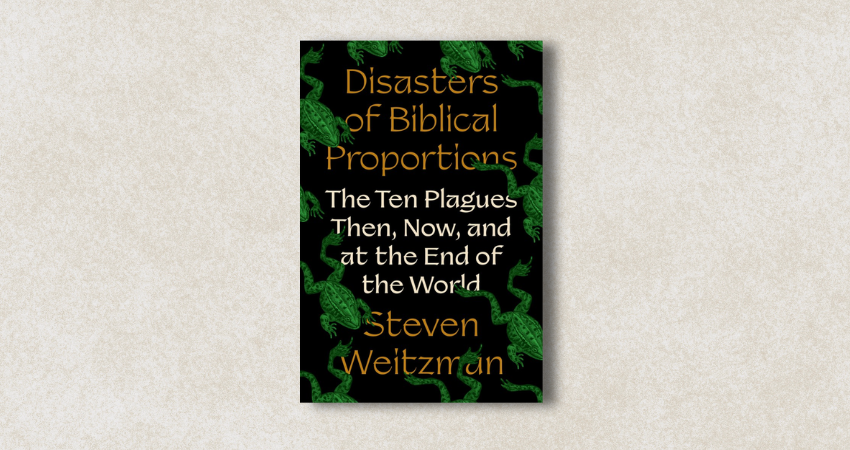
Review: Disasters of Biblical Proportions, Steven Weitzman, Princeton
During the American Civil War, it was relatively easy, and common, for anti-slavery campaigners to draw parallels between the biblical Exodus story and the plight of African American slaves. Campaigners even compared Abraham Lincoln to Pharaoh, arguing that the ills experienced by American society (rivers of blood, deaths of first-born sons, a moral darkness over the land) would not end until Lincoln set the slaves free. This is just one example cited by Steven Weitzman in his book about how the biblical plagues have been interpreted over millennia.
The plagues story possibly means more to Jewish people than to Christians, seeing as it is central to Jewish narrative, where it is not so much commemorated as relived, in a sense, at Passover. (Of course, though, calling Jesus the Passover lamb was quickly taken up by Christians.) Being Jewish, Weitzman explains midrash and the Exodus story’s significance for Passover celebrations, but he also elaborates on how it features in Apocalyptic literature and the Quran. He is not so much interested in whether the plagues could somehow have some historical basis or how they were recorded, but, rather, is interested in their ‘reception history’ and how they have been used to talk about contemporary disasters and moral failings. He apologises for the incomplete coverage, but there is plenty here.
Some scholars see the plagues story as a Hebraic inversion of and critique of Egyptian nature gods. In the context of the Old Testament, the exact number of plagues isn’t important, and subsequent Jewish writings often mix them up. ‘Plagues’ is not entirely accurate either: a river of blood is neither pest nor sickness. (But ‘the Ten Inconveniences’ would be a less evocative title.) As ‘signs and wonders’, though, they are significant for the gospel writers, who also describe Jesus as working ‘signs and wonders’.
The finer points of the story have been debated. Early Jewish and Christian interpreters wondered why Egyptian magicians could replicate the first three plagues but no more – and why they would want to. They also wondered why the magicians could conjure frogs but not lice. Scholars pointed to demonic powers that could not quite match God. In the Middle Ages, although there were panics over witchcraft, there were those who read the plagues as illusions being exposed as fraudulent, rather than being demonically inspired.
Whether the plagues are merely extreme divine coercion or retribution is not exactly answered in Exodus, but later interpretations saw them as punishments. Locusts, a regular pest in the Middle East, have historically been seen as a divine message or punishment. During an outbreak in Palestine in the twentieth century, European visitors wondered why locals, resigned to their fate, did nothing to repel the winged invaders.
The changing of Pharaoh’s mind prompted speculation on how much free will we have; even Saint Paul speculated on this. Later, Pelagius used the example of Pharaoh to argue against Saint Augustine. The debate would be revived in the Reformation and hasn’t gone away; part of the problem is that the plagues story, as it appears, is ambiguous on the issue of Pharaoh’s will – while a change of Pharaoh’s mind (or heart) is the seeming point of the plagues, the story also specifies that God intervenes to harden Pharaoh’s heart.
The plagues can change while retaining the symbolism. The postmodern philosopher Jacques Derrida includes a list of capitalistic plagues in his work. Other activists do the same. Modern, politically left-leaning Jews recite a modern version of the plagues at Passover to acknowledge current injustices – a nice practice.
In keeping with the early church’s emphasis on allegorical readings, Origen creatively compared the plagues to various types of worldly wisdom Christians must reject. A sermon attributed to Saint Augustine contrasted the plagues with the ten commandments, and this framing was enthusiastically taken up in the Middle Ages. As early as the second century BC, the days of darkness were interpreted as a moral darkness. By the nineteenth century the darkness over Egypt was interpreted as referring to the supposed backwardness of Africans. In contrast, in the Civil Rights era, Martin Luther King spoke of the punishment God was bringing down on racist white America.
Benjamin Netanyahu evoked the plagues when responding to the October 7 attacks by Hamas. Some Jewish journalists, in turn, used the plagues story to criticise Netanyahu’s retaliatory destruction of Gaza. In 1948, the Israeli Defence Force, attacking Egypt, labelled their campaign ‘Operation Ten Plagues’, but this is controversial, even in Israeli circles, for the violent propaganda that accompanied it.
The 2011 end-of-the-world film Melancholia references the plagues – or at least one of them. In Cecil DeMille’s famous film The Ten Commandments, the death of the first-born, the tenth plague, is envisaged as a creeping toxic cloud. (Metallica has a song about the final ‘plague’ entitled, appropriately, ‘Creeping Death’.) But in that same film, a scene with frogs, filmed using artificial ones, was cut because they seemed too humorous. Weitzman, though, in writing about why we find frogs funny rather than horrifying, notes the role of humour in Jewish biblical scholarship, which is often used to deflate pretensions.
Weitzman writes about how during the Covid pandemic, it gave him a vivid sense of what fear the biblical writers were trying to evoke in the story of the tenth plague. Apparently, during the pandemic, some Catholics put red ribbons on their doorposts to ward off the plague (either literally or symbolically), a practice which recalls the medieval Agnus Dei rite, which used wax medallions to (supposedly) ward off illness, itself a reinterpretation of the biblical story of blood on the doorposts, with Jesus as sacrificial lamb.

Weitzman recognises that the plagues are almost endlessly malleable symbolism. Although he doesn’t go into it much, they can, of course, lend themselves to symbolically, and sometimes literally, describing our current environmental predicament – the disasters that are a consequence of our holding the natural world in forced servitude to human ambition and overreach.
Nick Mattiske blogs on books at coburgreviewofbooks.wordpress.com and is the illustrator of Thoughts That Feel So Big.