

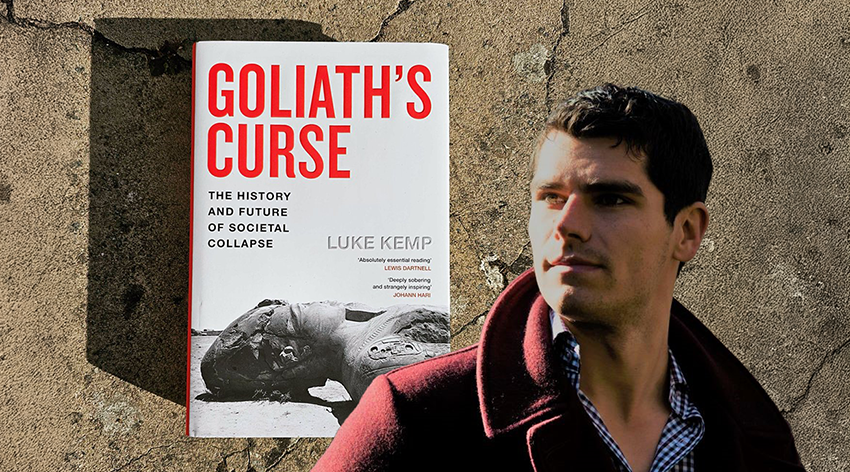
Review: Goliath’s Curse: The History and Future of Societal Collapses, Luke Kemp, Penguin
In his book of collapsology, Luke Kemp turns much received wisdom about barbarism and civilisation on its head. It’s the product of an enormous amount of research and contemplation, and it’s a goliath of a book, partly because he tends to repeat his argument, though it’s an important argument, and, importantly, optimistic, despite the theme of recurring societal collapses.
His argument is that we used to live in hunter-gatherer bands where, of course, there was a lack of things like modern medicine, but where the possibility of one group of elites becoming wealthy and powerful just wasn’t there. Resources were generally abundant; if not, we moved on, which left the environment to recover.
Ten-thousand years ago, when civilisations arose in the Middle East and China, the domestication of plants and animals allowed for sedentary living, which then allowed for the building of more substantial structures and the storing of crops and livestock, which then could be taxed. This allowed some members of society to become a ruling elite, with weapons that could allow domination. They could also wage war, so neighbouring societies, who were hoarding their own resources, were forced also to weaponise or be subjugated by their neighbours.
Technology and politics developed, and citizens were told that this was progress. Leaders, however, rather than being those best skilled at bettering the lives of all, tended to be greedy, violent, psychotic. (Today’s leaders, Kemp tells us, are likewise usually simply the best at manipulation rather than innovation and service.) They governed not for the people, but for their own interests, and nepotism, corruption and the bloating of bureaucracies became the norm. States became ‘Goliaths’.
Society was structured for the good of the ruling elites who controlled information and resources. Religion was often used to mythologise that this was the best way, and the divinely instituted way (much like how, today, we are told that there are no feasible options other than a globalised market). As exploitation of the masses and external conquest expanded, elites became more loathed and their societies more environmentally reckless. The foundations of society became unstable, the elites teetered at the top, and when environmental pressures, such as climate change, floods or volcanoes, or war arrived, societies collapsed. As empires got larger, control got bigger, but so did the risks.
Kemp rightly asks rhetorically why citizens would allow themselves to be subjugated if civilisation wasn’t as good as it was made out to be. He argues that civilisation was likely forced upon them; once the problems of being ruled became apparent, escape was difficult – this is evidenced by, across the world, repeated patterns of cities emerging, inequalities increasing, then rebellion and abandonment. (Intriguingly, the likes of French theologian Jacques Ellul notes a hint of suspicion of cities in the sacred literature of the largely nomadic early Israelites.)
After collapse, societies are good at reorganising at the grassroots – just think of how community spirit kicks in after disasters like floods. There are initial shocks, but the evidence from places such as Cahokia, the mound-building civilisation of a thousand years ago in North America, shows that collapse is usually good for the average citizen, and laments over collapse are generally recorded by elites who lost their privileges. (Tech billionaires busy building bunkers in New Zealand in preparation for collapse are likely deluded in thinking they can create immunity, says Kemp.)
Inevitably, this is a book about how to learn from the past, and although Kemp has been criticised for offering easy solutions, this is not true: he lays out the difficulties of wrestling power from demagogues and redistributing it more fairly and with the longer term in mind – a ‘Herculean task’. He writes, though, that collapse is not inevitable, even though history shows how there is a trajectory that is repeated across civilisations.

If left to run their course, civilisations will collapse, but there are things we can do to prevent it. And now we must, because the world is so interconnected (as the recent Trump-induced oil shocks have shown) and the threats so large, and a global collapse would be catastrophic. Kemp insists that we remember that things can be different – as he says, during Covid, we were surprised at how quickly governments can pivot if they need to – and we can prioritise horizontal over vertical relationships, a grassroots community spirit. And if collapse, or partial collapse, comes, while it is no longer certain it will be better for the majority in the long run anyway, we will be better placed to embark on the road to recovery.
Nick Mattiske blogs on books at coburgreviewofbooks.wordpress.com and is the illustrator of Thoughts That Feel So Big.