


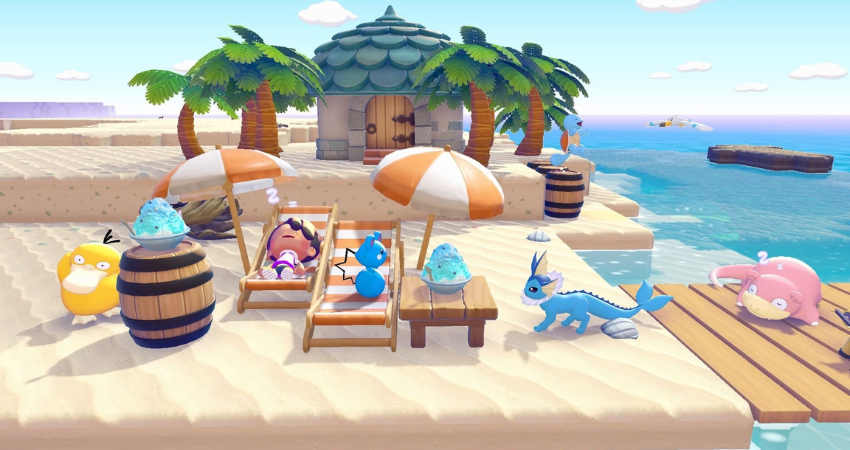
Review: Pokémon Pokopia
The Pokémon series turned 30 recently, and across three decades of games, cartoons, movies and endless merchandise, there have been a lot of different ways to engage with it. But the core appeal of Pokémon has remained the same the whole time – imagining that you have a special, unique bond with a team of lovely creatures. Pokémon Pokopia adds an interesting wrinkle: it removes us, humanity, from the equation entirely, and asks us to rebuild society alongside a bunch of Pokémon who, the game makes clear, dearly miss their humans.
Yes, Pokémon Pokopia is the series’ take on a kind-of-sort-of post-apocalypse, a world where you travel across numerous blighted regions and restore Pokémon habitats in the hope that a sense of livelihood can be restored to a desolate landscape. You play as a Ditto, a Pokémon that can, famously, take on the form of any other Pokémon – but this one has instead taken on the shape of its absent trainer. You gain new abilities by learning them from other Pokémon, and the core experience involves a lot of terraforming and building – you can smash up each environment, take the blocks of material left behind, and then rebuild as you see fit.
Pokopia is a truly enormous game, which can be quite intimidating. The more you explore, the clearer it becomes that the world you’re inhabiting – modeled on Kanto from the original games – is absolutely packed full of things to discover. Knock through a wall with your rock smash ability and you might discover a hidden cave; build a bridge to a distant island and there could be new items and Pokémon over there; restructure your town and you might find yourself thinking about irrigation systems, or how to best distribute electricity, or how best to decorate an entire street of houses.
Pokopia is a game you can play at your own pace. There’s a story to follow, and if you want to focus on the core objectives and move through it a bit faster, that’s an option: you’ll still unlock a bunch of Pokémon to pal around with and learn many new abilities this way. But I found that the appeal of digging around, mentally mapping out each new zone, exploring and learning, was irresistible. This is a game where every time I’d jump in, I’d find myself following some new whim: trying to gather resources, or re-organising my storage boxes to sort my materials more effectively, or just walking through an area talking to all the Pokémon to learn what I could be doing to make them happier.
Keeping all of these Pokémon happy with their living arrangements is one of the game’s core mechanics, which is pretty lovely. As you complete quests for them, and living conditions improve, the world of Pokopia brightens and expands – and if you stick with it long enough, you’ll eventually find yourself thinking about what it would take to fundamentally rebuild this broken society. It’s fairly heady stuff for a game about Pokémon, but Pokopia never gets too maudlin about it.
There is a logic to your actions that is easy enough to keep track of. You can spray water to wet soil, then use “leafage” to grow plants, which might result in a new Pokémon habitat forming. If you want to grow vegetables you need to till the soil first, and if you want electricity for an area you’ll have to build a working power grid of poles – nothing’s too complicated, but you need to really think about how different elements of society function to move ahead. You can build with any blocks you find, but you’ll need soil to grow vegetables; buildings should be made of something hardier, like brick; if you need lumber you can take logs to a Pokémon with a cut ability, whereas a Grass-type can help plants grow, and a fire-type can light a campfire, and so on.
The game’s size can occasionally lead to issues, though. Your inventory space is limited, and my regions are a mess of storage boxes now – they’re not interconnected, so trying to access something specific you stored for later can be a tedious process (especially when crafting out of materials you’ve collected is a major mechanic).. Keeping track of every mission you’ve been given, and every ability possessed by the Pokémon you’ve met, can be daunting, and the real-time nature of developing certain buildings means that you really need to manage your time. This can sometimes feel antithetical to the chill vibes Pokopia is trying to cultivate.

But any friction in Pokopia is a consequence of ambition, which this game has in enormous quantities. It’s a hopeful, sad, lovely experience, full of many small moments that all add up to something epic in scale. Play the game for long enough and you’ll create something close to a utopia – a world full of happy Pokémon, celebrating together – but making that world also means reckoning with why humans are no longer in it. The Pokémon series has sometimes dabbled in social commentary, but Pokopia‘s examination of community building is something entirely new. It’s beautiful and moving, but also fun and silly. It’s a game that perfectly exemplifies why Pokémon has endured for 30 years – and why it will remain important for many more.
Pokémon Pokopia is available now on Nintendo Switch 2. A review copy was provided by the publisher.
James O’Connor has been writing about games since 2008. He is the author of Untitled Goose Game for Boss Fight Books.