
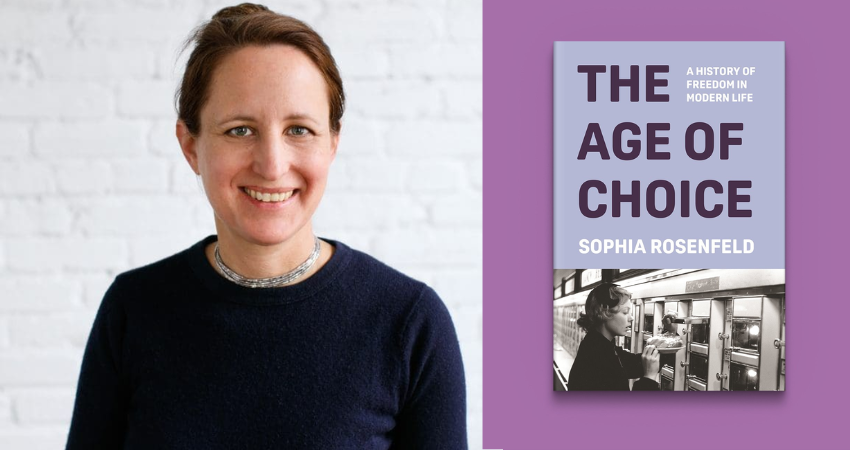
Review: The Age of Choice, Sophia Rosenfeld, Princeton
Five hundred years ago most people didn’t get to choose their education, church, work, where they lived, who they were ruled by, and how many children they had. Choices in food were limited (usually by the seasons), as was the information about the rest of the world. Most were limited in choice of marriage partners, and generally they were chosen for them.
Now, even if we don’t choose our parents, we get to choose our lovers and friends. Migrants arriving in the West often comment on the abundant variety in supermarkets – consumer choice is one of the markers of our society. (In Australia, we even needed a magazine to help us navigate the bewildering array.) Beyond this, Western democracies are built on being able to participate in choosing the government, and on choosing a belief system, including but not limited to the religious, free from harassment (as long as your choice doesn’t impede someone else’s).
In her book, Sophia Rosenfeld notes how modern are our assumptions about choices. In the past people generally saw choice as being between right and wrong. These days we are more likely to view choice as over equally ranked things. (This is true even in the realm of politics, where, in more sober moments we acknowledge that our mainstream parties generally just have different emphases.) Pluralism rules.
Rosenfeld traces a modern emphasis on choice to the Reformation and the beginnings of consumer culture, enabled by technological advances. She moves from the use of catalogues by a pioneering auction house in London in the eighteenth century, where the word ‘choice’ was used as an adjective, as in ‘valuable’, to how bow windows in Bath allowed merchants to better tempt passers-by, to the Paris arcades, where simply admiring the choice on offer was a pastime.
We might add a caveat to the point about the Reformation: individualism in the Reformation led unintentionally to the freedom to believe a variety of things. Rosenfeld notes that, ironically, the Reformers actually insisted on a lack of choice: it was all God’s doing if you were saved or not. (This has been, in a further irony, promoted within Protestantism as a kind of freedom.) It was only in the radical arm of the Reformation where choice reared its head: in (the heretical notion of) adult baptism.
The idea of choice in religion is a grey area. Voltaire said that compulsion in religion was not religion, so he emphasised choice (free will). But freedom of religion can be overemphasised. Converts could be compelled, the early United States was a religious marketplace in only a very limited sense. Revivals preyed on the susceptible, and it was believed women were particularly susceptible to religious charlatans. (Mary Wollstonecraft thought the same way about clothes shopping.) In the past, as now, religious affiliation was rarely a matter of weighing up the options and going with what we feel suits us best.
The push for wider participation in politics in the nineteenth century entailed some interesting debates about freedom and coercion. The secret ballot is now seen as a positive, allowing for the freedom of political choice, but it was not always viewed that way. John Stuart Mill, who argued for the female vote, thought it was a correct and solemn duty to make your vote in public; otherwise, voters could make a stupid choice unimpeded by their peers. But the argument that won the day was that coerced affiliations would disappear, and reason and conscience would reign in the voting booth. (One can look to the United States and wonder if this turned out to be true.)
In the US, the word ‘choice’ is weighed down, of course, by the issue of abortion. The right for women’s access is famously framed as ‘pro-choice’, coming from the Enlightenment philosophy, so central to American ideals, of the individual’s right to choose. But one of the arguments against abortion rights is that, as with other issues, personal choice is curtailed by its (harmful) effects on others. Or, as the anti-abortionists argue, there are other people involved, and what about their choices? The argument is that there is, at the very least, a selfishness involved. (It is no wonder then that feminism generally is often targeted for the same reasons, though Rosenfeld notes that men’s choices are far less likely to be framed that way.)
In the MAGA movement there is the strange conflation of proclamations of freedom (to own guns, etc.) with a desire to restrict political choice, to impose levels of uniformity, even to tolerate dictatorship. There is a confusion about the intrusion of government and the way government can enable choices, about the way the unguided economics of free markets limits the choices of many. Libertarians argue for choice, but largely this is so they can stick to the course of morally irresponsible wealth hoarding.
Rosenfeld is aware of the complexities of choice. Freedom of choice does entail boundaries. Freedom of choice is not anarchy. She brings up the example (symbolic of wider obligations) of nineteenth-century dances, which were venues for romantic matchmaking, as well as simply entertainment, but which had strict rules so that everyone understood what the choices of dance partners involved. So often in society, choices are steered by rules, conscious or otherwise.
Freud fudged the definition of choice, arguing that choice is often an illusion, driven by forces we don’t see, both within and without. This brings up the perennial philosophical conundrum of determinism and free will, though Freud thought that through an understanding of these hidden forces (through extensive analysis), our free will is rejuvenated.
Rosenfeld writes about how in the twentieth century, advertisers tried to understand these forces so the advertisers could direct choice. And despite how much we know about the psychological manipulation involved in advertising, most of us remain vulnerable. Advertisers give us the illusion that we are, through choice, fashioning an individual identity, a modern preoccupation that would be lost on most people in the, say, fifteenth century. Of course, while it has its upsides, much of modern life looks less like freedom and more like slavery to almost-endless contemplation and evaluation of arbitrary decisions, where there is always the danger of, like Buridan’s donkey, being paralysed by indecision. (I sometimes walk into a bookshop salivating at the prospect of new books and walk out again empty-handed, defeated by the difficulty of prioritising.)

The twentieth century saw a whole ‘science’ of choice, with competing ideas. Psychologists saw choice as an individual, sometimes irrational thing; economists argued that choice was rational – the market is always right. Sociologists framed the freedom to choose within the parameters of culture and society. Historians could trace contemporary choices to good or bad choices made in the past, a chain that looks less like freedom and more like simply cause and effect.
Nick Mattiske blogs on books at coburgreviewofbooks.wordpress.com and is the illustrator of Thoughts That Feel So Big.