


Review: Pokémon Legends: Z-A
The last few Pokémon RPGs on Switch – Legends Arceus, then Scarlet/Violet and their expansions – have had the feeling of a series at a tipping point. They’ve presented more open worlds, some new mechanics, and have gotten closer to the experience that those of us old enough to have loved this franchise for nearly 30 years have wanted all along: big, open worlds that feel alive, teeming with Pokémon to capture and train – but have also had pacing problems, technical issues, and uninspired environments. Still, there’s enough juice here that I happily put 70 hours into Scarlet, despite its bad reputation.
I think most players will prefer Pokémon Legends: Z-A to those previous games. It’s a smaller, more contained world, with a little less land to roam, but it’s also a much more stable game, set in a location that rewards players who take the time to really explore it. There’s an overhauled battle system and a progression model that feels streamlined and engaging; after the initial run of tutorials, Pokémon Z-A feels more like the open-world Pokémon game fans have always wanted than ever before. It’s not all the way there, but it’s another step closer, at least.
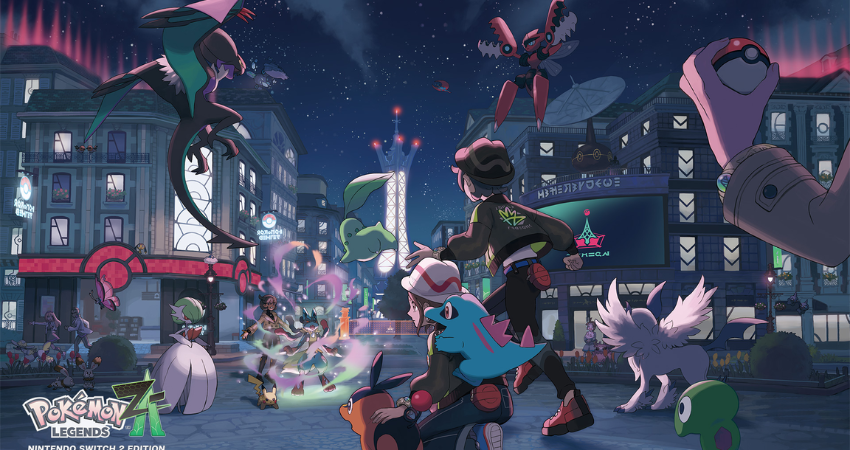
Pokémon Legends: Z-A is set in Lumiose City, which longtime fans might recognise as one of the key locations from Pokémon X/Y on the Nintendo 3DS. The city, which is loosely based on Paris, is a mix of wide-open streets filled with NPCs to meet and stores to visit, cloistered “wild zone” areas where you can fight and capture Pokémon, and a network of scaffolds and rooftops that can be traversed.
You play, as always, as a Pokémon neophyte who is given a choice of starter Pokémon at the game’s beginning (I went with Totodile; if I had my time again I’d have picked Tepig) and is soon told that they are unusually gifted at training these things for battle. The game’s odd name refers to an interesting custom in this town: there’s a ranked battle system that everyone is encouraged to rise up, and after starting at Rank Z you have to earn the rights to take part in various promotion battles until you hit Rank A.
Lumiose City is not a huge location, but it’s a dense one. I was surprised by how much there is to do in Z-A, and how much of it is compelling, or at least cute. Alongside the main story are side-quests to complete, which are rarely complex but are usually well written enough to be entertaining. Exploring the city, capturing Pokémon and finding items, remains enjoyable even several dozen hours into the game. As with all modern Pokémon RPGs, it’s a little bit ugly, with samey building designs and characters that tend to pop in a few meters ahead of you, but – on Switch 2, at least – it runs well, and the Pokémon themselves have a lot of personality in their animations. When night falls (which happens every 15 minutes or so) the city transforms, and you’ll be able to access battle zones where you can go and face off against other trainers. It can feel a little odd to play a Pokémon game where everything feels so segmented, including the game’s main missions, which involve climbing the ranks through these nightly fighting arenas and periodically battling wild Pokémon going through “Rogue Mega Evolution”, the game’s version of boss battles. But everything here is enjoyable, thanks in large part to the way battles have been tweaked and changed.
The battle system is a major shake-up from what we’ve seen in previous games in the series. They’re no longer turn-based, and you can control your Pokémon’s positioning by moving around the battlefield and using certain moves. All attacks now have cooldowns rather than a limited number of uses, and many moves have been reimagined to suit these changes. I’ve long felt that the battles were the part of Pokémon that most needed overhauling (at least in the single-player campaigns), and ZA’s system is smart and fun. In the wild zones you will often be ambushed by multiple Pokémon, including big, ultra-powerful “alpha” Pokémon with glowing red eyes; things can get hectic, but releasing your most powerful Pokémon and taking down a gang of attacking monsters while dodging their attacks can be very satisfying.
This is not going to be an entry for competitive play; there’s an online mode, but it’s a bit different from previous entries, throwing four players at once into a sort-of battle royale. That’s totally fine, though – the competitive scene will always center on the most recent “mainline” entry, and I’ve had a lot of fun with this mode, even if it’s mostly a matter of rushing in and using my team’s most powerful moves over and over.

Pokémon has always been a series that puts a lot of faith in its monster designs, and I’ve found that this entry left me feeling particularly connected to my team. My Ampharos, my Charizard, my Chesnaught, my Feraligatr – adventuring together in Lumiose has felt pretty great. Pokémon Legends: Z-A might not be the open-world 3D Pokémon game I’ve dreamed of since I was a child, but that hypothetical release now feels closer than ever.
Pokémon Legends: Z-A is available now on Switch and Switch 2. A Switch 2 review copy was provided by Nintendo for review.
James O’Connor has been writing about games and games since 2008. He is the author of Untitled Goose Game for Boss Fight Books.