


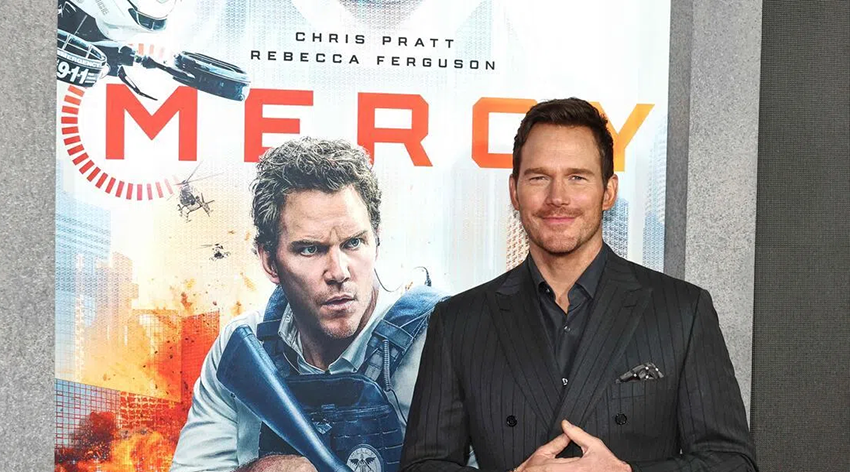
Chris Pratt’s new sci-fi thriller Mercy is in cinemas, casting him in a dramatically different light from the roguish charm of Guardians of the Galaxy or the affable action-hero energy of Jurassic World. In Mercy, Pratt plays a future-era LAPD detective racing against an artificial intelligence judge – and against the clock – to prove his innocence in his wife’s death. It’s a high-stakes story about justice, technology, and what it means to be truly judged.
Watching Mercy on the big screen, the film’s title and themes naturally raise questions about grace, justice, and what it means to seek mercy – not just from fallible institutions or artificial constructs, but from the One who offers true redemption. And that brings us back to the actor himself, who in his off-screen life has become known as much for his faith as for his box-office draws.
The recent RELEVANT Magazine Podcast’s Episode #1286, “Chris Pratt on Faith, Fame, and Finding Purpose Beyond Hollywood,” offers one of the most honest and formative accounts of Pratt’s spiritual journey – a story that resonates all the more in the context of a film like Mercy.
Pratt was no stranger to struggle before Hollywood change found him. In his early years, living in Hawaii, he drifted through life without anchoring himself to anything lasting. He worked as a waiter, lived out of a van, and often talked about life as a kind of blur – until a stranger’s invitation to church setting him on a path he later described as the beginning of his relationship with Christ. It wasn’t instantaneous perfection, but it marked the start of his spiritual transformation.
In Relevant Podcast #1286, Pratt recounts that transformation not as a polished testimony, but as a lived experience — messy, ongoing, and marked by both struggle and surrender.
But perhaps the most pivotal chapter came later, with the birth of his first son. Pratt’s son, Jack, was born prematurely and fought for his survival, and in that crisis Pratt prayed with a desperation that many listeners can recognize: “If You save my son, I’ll give You everything. I’ll give You my life, I’ll give You my platform…” Whether spoken aloud or in whispered prayer, that moment became a spiritual watershed. Jack survived. Pratt says his faith did more than endure, it deepened.
What’s so compelling about Pratt’s faith, and what comes through clearly in Relevant Podcast #1286, is how he frames it: not as a polished public relations message, but as a genuine dependence on Jesus. Pratt doesn’t couch his belief in vaguely inspirational terms; he speaks directly about Jesus shaping his life and giving him purpose beyond applause, box office totals, or industry accolades.
This matters because faith is often misunderstood as something people tick off like a box, especially in Hollywood where religion can be reduced to brand or image. Pratt rejects that. He says his platform isn’t a place to carve out followers for himself; it’s a place to point others to the One who changed his life.
In a culture that prizes self-promotion and celebrity, this kind of humility can be mistaken for naivete. Instead, Pratt sees it as obedience. As he’s said in other interviews, that his journey with God is ongoing, messy, and deeply personal — not sanitized for social media feeds or red carpet moments.
And so Mercy – a film about a man judged by a cold system and scrambling to prove his case – is rich with symbolism. The title itself echoes a truth at the heart of the Gospel: we are all, in one way or another, standing before a judge greater than any court or algorithm. We cannot win justice on our own merit. We need mercy. We need grace. We need the kind of forgiveness that only God can grant.
Pratt’s own testimony, a story of sin recognised, burdens surrendered, and a life reshaped by grace – illustrates that better than any Hollywood speech. In Mercy, audiences see a fictional struggle for innocence. In real life, Pratt points to the truth that Christ not only defends the guilty, He redeems them.
Pratt’s Christian witness hasn’t been without pushback. In Hollywood – where faith often takes a back seat to secular narratives – speaking openly about belief can draw scrutiny, misunderstanding, and sometimes ridicule. Yet Pratt doesn’t shy from it. He has said plainly, “I care enough about Jesus to take a stand, even if it costs me.”
But what’s equally clear is that his faith isn’t born out of obligation but gratitude. In times of disaster – like wildfires that threatened his home – he publicly thanked God, attributing survival and shelter to divine grace.
As Pratt himself explained with refreshing candour on the Relevant Podcast, faith isn’t about being perfect. It’s about acknowledging imperfection, experiencing forgiveness, and walking forward with humility and courage. That’s a message worth embracing — whether or not you leave the cinema thinking about Mercy’s twists and turns.
So what might Chris Pratt’s story – both on screen in Mercy and off screen in his walk with God – say to us?
Maybe this: that justice without mercy is hollow, and that mercy without justice finds its ultimate meaning in Christ. Pratt’s life suggests that when we surrender our platforms, our talents, and even our fears to God, our stories can point others to hope that far transcends the brightest marquee or the loudest applause.
And that’s a message worth hearing – whether you’re in a darkened theatre watching a thriller unfold, or walking through the everyday trials of your own life.