


Review: Onimusha: Way of the Sword
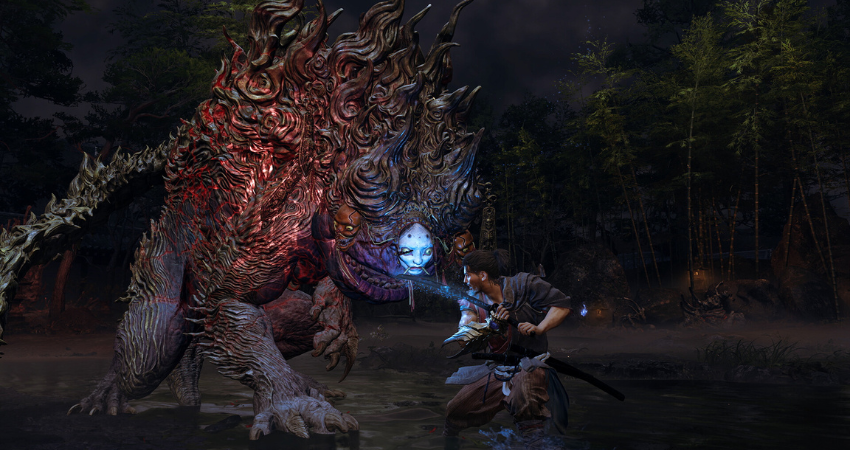
The best moments in Onimusha: Way of the Sword center around anticipation. You face an enemy, slowly circling each other. They raise their sword, as though to attack, and you plan your defense. You can block the blow if you want to take the safest route, parry if you think you can time it just right, or deflect if you’re bold and want to stagger them. Perhaps you’ll need to dodge out of the way, or – if you’re feeling really confident – you can try an issen counterattack, an immensely rewarding and powerful strike that needs to be timed perfectly, but which can end the fight immediately. There are sometimes right approaches and wrong approaches, and it’s up to you to read your opponent and figure out what to do.
The game follows Miyamoto Musashi, a ronin samurai in the year 1604, loosely modeled on the great Japanese actor Toshiro Mifune. The aforementioned issen counterattack, done right, is just as satisfying as the famous duel from Akira Kurosawa’s movie Sanjuro, when Mifune’s eponymous samurai reads his enemy perfectly and puts them down in one slash. If you lose your cool and time your counter incorrectly, it can be embarrassing – even the basic enemies in the game can do huge damage – but sometimes Mifune lost, too.
Onimusha: Way of the Sword is a legacy sequel to a series of games on the PlayStation 2, but you don’t need to have played those to enjoy this one. In the game’s opening hour, Musashi meets his end to the sword of a mysterious supernatural enemy, and – after a quick trip to the afterlife – he is soon returned to Kyoto with a glowing gauntlet attached to his arm that lets him take on a horde of invading demons. From here, the game is divided between different missions across the game’s small open map; you move between locations, fighting enemies, hunting down items that can be used to upgrade your abilities or strengthen yourself during fights, and progressing the plot.
The story is neither here nor there: it has some fun references to historical figures and events, but never feels like it is building to anything too special. But Musashi is an excellent character, brought to life by top notch animation work: the way he strokes his chin, his annoyed snarl, and even the way he snatches and resheathes his katana feel extremely grounded, which is important for a game about dueling enormous beasts and monsters.
The excellent animation makes for extremely satisfying fights. Landing a deflection might cause a mass of sparks to fly as swords clash, and reading an enemy’s body language is important to judge your next move. Paying attention is so important that I found myself thinking about Onimusha quite differently from how I usually think about action games. The real battle happens in your mind, not on the screen.
Your mileage may vary on the level of challenge Onimusha presents. As a player who is prone to panicking during intense combat, I sometimes struggled with the timing this game demands. But more than once I stepped away from a boss I was struggling to defeat, spent some time visualising their attacks, and then returned to the game better prepared. In one instance I stopped playing for a full week, unsure if I could pass a boss that was giving me a lot of grief; when I returned, calmer and ready, I was able to defeat it on my first attempt, having developed a better understanding of my opponent.
Onimusha really rewards you for learning its systems. A fight that feels impossible the first time might feel like it’s within your grasp a few tries later, as you start to get to grips with how they move and what you need to do in response. It’s this feeling of control and betterment, the sense that Onimusha has given you the tools to improve and is constantly teaching you how to play and understand it, that makes this such an effective, enjoyable action game. Finally taking down a huge, intimidating boss feels great, but the same is also true for landing a perfect counterattack on the lowliest enemy in the game.
I played Onimusha on the Nintendo Switch 2, and it’s an excellent port. If you play the game on a more powerful system, there’s some extra visual sheen and a 60fps mode; on Switch 2, though, it still looks fantastic, and with variable frame rate enabled it feels like it’s hovering around 40fps most of the time. For a game like this, when stability matters, it’s really excellent to have it perform so well. The graphics take a hit in portable mode, but that’s to be expected – and even then, it looks stunning. If you like the option of playing on the go, this version does not feel compromised.

There are flaws I could point to in the game – some iffy exploration segments, repetition in certain sequences, large dumps of exposition in cutscenes – but those aren’t the parts of the game I find myself thinking about between play sessions. Despite your enemies all being monsters, Onimusha: Way of the Sword feels more like a classic, grounded samurai film than any game I’ve ever played, and its combat system is an all-timer.
Onimusha: Way of the Sword is available on PC, PlayStation 5, Xbox Series X/S and Nintendo Switch 2. A Nintendo Switch 2 copy was provided for this review.
James O’Connor has been writing about games since 2008. He is the author of Untitled Goose Game for Boss Fight Books.