


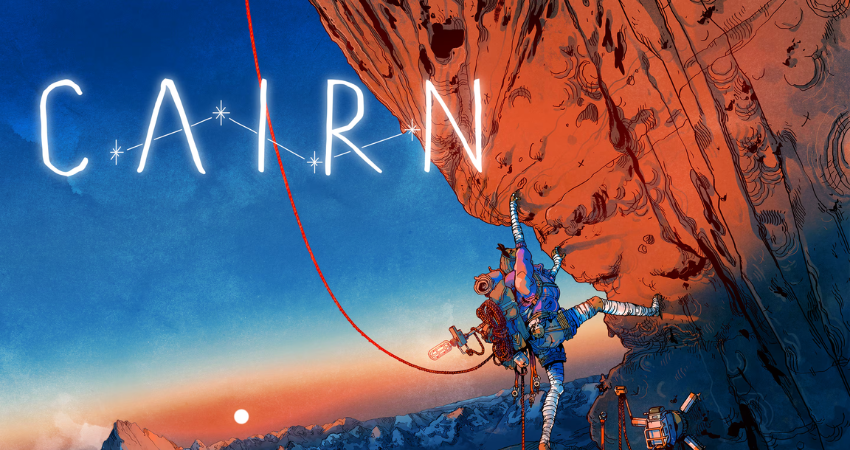
Review: Cairn
There’s a scene midway through Cairn, the mountain-climbing epic from independent developer The Game Bakers, where main character Aava speaks with another climber about what pushes her to keep climbing. In her words, during moments of beauty and solitude, when she stands alone on a peak she has scaled, it’s not just that she has conquered the mountain: she is the mountain.
For players, this is a statement that carries a lot of meaning – not just because we’ve been actively fighting the whims of this mountain as we climb it, but also because of what we’ve come to understand about Aava – and, perhaps, ourselves – in the time we’ve spent playing. Cairn is a game about climbing a mountain, but it’s also a game about why you might climb a mountain, and its storytelling instincts are sharp enough to understand that the answer is complicated.
Cairn is a clever game, one that is built on one of the most fundamental sources of pleasure in a game – doing something you could never do in real life. Aava, the game’s protagonist, is on a journey to become the first person ever to scale to the peak of Mount Kami, and you’re with her for almost the entire journey. As you face each new wall of rock – and there are a great many walls of rock on Mount Kami – it’s up to you to observe the path ahead, plan out a route, and then execute on it.
There have been many games about climbing, but Cairn is uncommon in its level of fidelity. At its core, climbing the mountain is all about placement of your hands and feet – you can control each limb in turn, lifting them with a press of a button, moving them, and then putting them back down with the same button. You need to make sure you are not stretching your body too far, that you have adequate grip, that the path you have chosen is possible. Sometimes, midway through a climb, you’ll hit a section of wall you cannot find a way up, and you might need to replan. You really need to think about your placement, and what’s possible for a human body. It feels more “real” than any other game I’ve played that involves mountain climbing.
All the while, Aava may grow hungry, or tired, or need water in her belly and chalk on her hands. A large part of the game is resource management, making sure that the limited space in your backpack is being put to good use. You can cook or mix drinks whenever you find a save point and pitch your tent, while other functions can be completed during the climb – as long as you cram a piton into the rock to hang safely for a moment – so progressing up the mountain means constantly keeping track of Aava’s needs.
The worry you feel during a difficult climb is compounded by the fact that you’re slowly working your way through your supplies as you go. Reaching a new peak and finding a stream with fish, or an edible plant, or even a box of supplies left by a previous climber who didn’t make it to the top, is a huge relief, but you always know these things aren’t guaranteed on every climb. It’s clear that a lot of thought has gone into balancing Cairn‘s difficulty – it’s very challenging, and sometimes you’ll hit a wall that feels impossible to scale at first glance, but there’s always a way forward. Aava can fall to her death, which can wipe out considerable progress if you have not saved for a while – which is frustrating, but a necessary part of the experience.
Cairn’s story is really about two characters: Aava and Mount Kami. If Aava feels like she is the mountain, then certainly it makes sense that the mountain also feels like it’s alive. As you climb, you discover mini-narratives about the mountain’s history: the remains of long-dead climbers, the remnants of abandoned societies, tools and food and messages left behind by people who had to abandon their own quests to conquer Kami. Cairn strikes an interesting balance in its storytelling: Aava is selfish and blunt, but her journey makes sense to us as players, because by playing the game we’re on that journey, too, and the idea of reaching the summit really is exciting.

Cairn is a huge game made by a relatively small team, and inevitably there are some bugs and performance hitches – sometimes Aava’s limbs will bend in weird ways, or the frame rate will tank for a few seconds, but that’s because the development team, like Aava herself, have taken on and conquered an enormous challenge in building such a complex, engrossing game. For Aava, the summit is everything; for players, it’s the climb that makes Cairn special.
Cairn is available now on PC and PlayStation 5. A PlayStation 5 review copy was provided for review.
James O’Connor has been writing about games and games since 2008. He is the author of Untitled Goose Game for Boss Fight Books.