

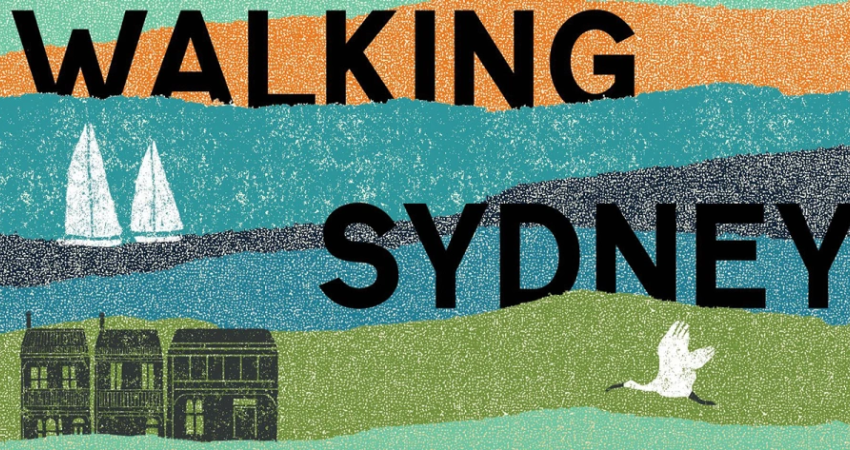
Review: Walking Sydney: Fifteen Walks with a City’s Writers, Belinda Castles, Newsouth
When we lived in Balmain years ago, my wife and I would walk from Gladstone Park on Darling St, over the hill and along past the container port, winding through streets of terraces and the occasional, larger colonial mansion, up old steps only locals know about, down to the end of eastern Balmain, with its ferry terminal, fig-encrusted stone walls and views across to what is now Barangaroo and, further, the vast Bridge. There were myriad points of interest: sandstone boulders incorporated into foundations, frangipani flowers spilling onto the path, sparkling harbour glimpses, remnants of old working-class Balmain and other whispers of history – sensations reinforcing our sense of the city’s character.
As Belinda Castles explains, we understand a city through walking – and conversely, if we don’t walk it, we don’t understand it. This is one of the insights of the pioneers of what would be called psychogeography, an outlook and process that deliberately pits itself against the idea of the city as a place primarily of commerce and industry and puts people back at the centre of the city and its purpose. It’s a receptive stance (or gait, I suppose). One of Castles’ walking companions talks of yindyamarra, an Aboriginal term that means something like walking slowly and respectfully. Most people have lost this valuable art, says writer Malcolm Knox in one of the perambulatory interactions with Castles.
This book of literary conversations taken on the hoof (a companion to Newsouth Publishing’s recent Swimming Sydney) deepens the pleasure of walking by recounting the history that underlays Sydney’s paths and by being guided by the topography. Its lack of a grid-like structure, at least in the east, makes for more torturous driving, but the meandering layout, necessitated by the irregularities of nature, including the tentacled reach of the harbour, lends itself to a meandering walking that is open to possibility and surprise. And, of course, there is something democratic about walking – especially in a city which leans so often towards conspicuous wealth.
As with Balmain (which isn’t given a chapter here, but no matter), Delia Falconer talks about, in Rushcutters Bay, how the vast geological skeleton of the area – the Triassic sandstone – presses through at points, reminding us of deep time. Aesthetically, the sunny warmth of sandstone, in jutting cliffs and repurposed into buildings, contrasts nicely with the blue of skies and water. Falconer talks of the ‘craggy’ landscape and a ‘shagginess’.
In the suburbs north of the city Jakelin Troy describes the trees, with gnarled trunks, mottled leaves and oozing sap, the birds – kookaburras and currawongs – and native bees. Here it is more bush than gardens, something that drew modernist architects, including Jorn Utzon, and artists such as Margaret Preston. In Sydney, suburbia dramatically gives way to not so much farmland as in other cities, but to lush and ‘craggy’ wilderness, making it accessible in many locations.
On a walk with Gail Jones, Castles notes the contrasts between the harbour views and the city bustle, between the glass/steel towers and the sandstone colonial buildings. They meander through the Rocks, from the precinct of Circular Quay, up the hill where things can suddenly seem quiet, even with the hum of the Bridge overhead. (‘A wonderful sound,’ says Jones.) There’s the contrast between the flat of the harbour and the verticality of the city, and between the serenity of the water and its recreational aspects and the commerce-obsessed city, always future-looking, always running rough-shod over the past if it is allowed.
A city could be almost defined as a site of constant change – Parramatta is constantly unfinished, there are controversies over which parts of the colonial past should be protected, against the need for denser housing and the muscle-flexing of lucrative sports bodies. The Eveleigh railway yards have been repurposed for art, the city’s industrial past slowly dissolves, social housing is pushed to the margins.
Novelist Fiona Kelly McGregor talks about the notorious slums of Surry Hills, a suburb now leafy and gentrified, and the outrageous women that provided inspiration for the novels of Ruth Park and her own. For McGregor, fiction overlays non-fiction, and she hunts through old maps to better match the two. Mohammed Ahmad talks about how the new Bankstown Western Sydney Uni campus takes some getting used to, but he also enthuses over how such buildings put learning out in the open, rather than in cloistered privilege, which is particularly inspiring for new arrivals.
Location influences identity. Larissa Behrendt talks about the history of Redfern and the ‘Block’, which of course had its notoriety but also cultivated community and was one of the key sites for the fermentation of Aboriginal activism. She notes the tension that remains, at sites like the War Memorial in Hyde Park, built on a traditional Aboriginal meeting place, where a colonial past is still reinforced but where, also, there is a reminder to non-Indigenous Australia, in the giant bullet sculptures of Tony Albert, not only of Aboriginal possession but also of contribution.
Vanessa Berry, a thorough chronicler of retro Sydney, talks about how she would, in her younger days, walk the streets of Newtown, visiting op shops and bookshops, working out who she was, just like, now, the goths who haunt the graveyard off King Street. Despite the furious pace of change, she notes the signs of the recent past – remnants of closed shops, including the infamous Gould’s Book Arcade, which downsized and relocated almost a decade ago, the cavernous but crammed interior fondly remembered by some of us, not so much because you could readily find something you were looking for but more because there was a tantalising chance you might, against the odds. Of course books feature heavily in Castles’ book – not just bookshops and novels inspired by Sydney, by contemporary writers and those before them, but also the sites of literary events.

It is not just the traditionally picturesque and desirable areas that get a mention here. The imagination of Michelle de Krester, alert to Sydney’s distinctiveness by being a recent escapee from Melbourne, turns the inner West into a mysterious, verdant paradise. It’s great that we now have novelists who see Western Sydney as a fertile place for fiction. Novelist Max Easton provocatively, but perhaps with a more egalitarian mindset, argues that the city is not the centre of Sydney – he speaks of always thinking of the city as ‘east’ and the West as the centre.
Nick Mattiske blogs on books at coburgreviewofbooks.wordpress.com and is the illustrator of Thoughts That Feel So Big.